
“Now It’s Our Turn”: Astrolabe’s François Hercouet on Building a New Comic Publisher in France
With nothing but love to every other comic publisher, Urban Comics is my favorite in all the land.
The French comic house works with publishers like DC Comics, Image Comics (as well as the assorted creators who publish through them), and others to bring American comics to life in France, and what an incredible job they do. Every edition they publish seems to elevate the original work to previously unthinkable levels with the design, production value, and pure passion for comics they bring to the project, as they’re able to look at works in a pure way when they’re creating new collections of the great titles they publish. That allows them to innovate in interesting ways, which is the reason they’re the foundation of DC’s Compact Comics through the Urban Nomad program they created for the publisher in their lab in France.
As incredible as they are at all that, the one thing they’ve never done is publish original comics — until now. That’s because Urban’s editorial director François Hercouet and his team have created a sister company called Astrolabe, one where they’re publishing new comics from exciting names like Sean Murphy, 3 Ram V, James Tynion IV, Matteo Scalera, and more. It’s not all direct market superstars, as their first project was the gorgeous Pourpre-Sang from debuting cartoonist Léo Chérel, but the point is, Astrolabe is about pouring all that love and energy for comics into original stories, all with the touch they’re known for from Urban.
And as a Urban superfan, I had to know more about what they’re building over at Astrolabe, as well as how it fits within the increasingly robust pipeline of direct market creators thinking International first with their stories. So, I did just that by sitting down with Hercouet for an extended conversation about Astrolabe, what they’re building, how it works, how it fits within that aforementioned trend, where Urban fits in all this, and more. It is, as all things are with Hercouet, splendid, and you can read it below, although it’s been edited for length and clarity.
One last note. While the titles we’re talking about here are, for the most part, only in French as of right now and on the horizon, as with many International releases these days, don’t expect that to be the case for too long. There’s plenty more to come from all of these, I imagine.
You and your team have cooked up something new. Can you explain what Astrolabe is?
François Hercouet: With Urban Comics, we work as an adapter or packager to transform U.S. Comics for the French market. We are conscious that we are doing more than that, but our most creative input comes through the graphic design, the cover, the interior layout, the way we build collections, and how we position and publish each title. That’s where our creativity lives. That is our little angle of creativity.
With Astrolabe, we turn that little angle of creativity into a whole horizon. Basically, it’s our second form, our next evolution. Almost like a mutation (laughs). Years ago, our former director, Pôl Scorteccia, often referenced Picasso and reminded us that it takes about ten years of practice to truly master what you do. Although we were already dreaming about creating original projects, he believed we first needed to establish ourselves as a publisher before taking that next step. When we felt ready, we went into production. That was four or five years ago, and now, we see the results and we’re ready to release our first books in 2026.
I like the idea of a mutation because, after years of meeting writers and artists, sharing meals, attending conventions, and building friendships, creation naturally enters the conversation. You start asking yourselves, “What could we make together?” It was being in frequent contact with the creators that turned that question into a reality. In a way, it’s just a chemical reaction.
Throughout our ten years of adapting comics for the French market, we met many extraordinary creators. And over time, Urban Comics became more than just a name or “a French publisher.” We built lasting relationships and created a community that felt like a family.
So, 10 years after the creation of Urban Comics, we feel that we were ready to move to this second form of publishing, where we are actually engaging creators and projects to be released from A to Z.
Some projects will come from people we already admire, such as Matteo Scalera or Sean Murphy. Others will be born from new creative pairings, bringing together international and European talents in ways that might not have happened otherwise. We love the idea of creating those encounters and seeing what emerges from them. And of course, when a project feels right, we’ll also develop entirely French creations or with licenses we feel in sync with.
In many ways, Astrolabe is the culmination of passionate people who love comics, genre storytelling, and creating things together. But it’s also an act of exploration. The name Astrolabe wasn’t chosen by chance: it’s about navigating, discovering new territories, and finding your way through uncertain waters. Starting a new publishing venture in times like these feels very much like setting sail on an unknown sea. That’s what makes it both challenging and exciting!
Was something like Astrolabe always part of the plan for Urban? Or do you mean you had to evolve in the way Pôl was speaking to?
Hercouet: I think it was meant to be but not immediately. I think we could just have been content about what we were doing for 10 years. We could have done that forever. It’s something that feels natural now. But for some of the team, it was important to move to another step and be engaged in the creation process.
I wouldn’t say like it’s an entire new job, but nearly, because the timing is so different. The gestation period for this can be long. This can be challenging. I used to say that we, as a packager, are on the backseat of the real publishers at DC and Image. We had the best part of the job. We weren’t the ones in the trenches, wrestling with deadlines and making every page come to life. We were the people celebrating those books, bringing them to readers, spending time with authors, and helping make the final product shine.
But creating those pages in the first place, that’s the real challenge. And now it’s our turn to step into the arena. Working on original creations is teaching us that collaboration isn’t always easy. We don’t always see eye to eye with creators, and sometimes we have very different visions of what a book should be. That’s part of the process.
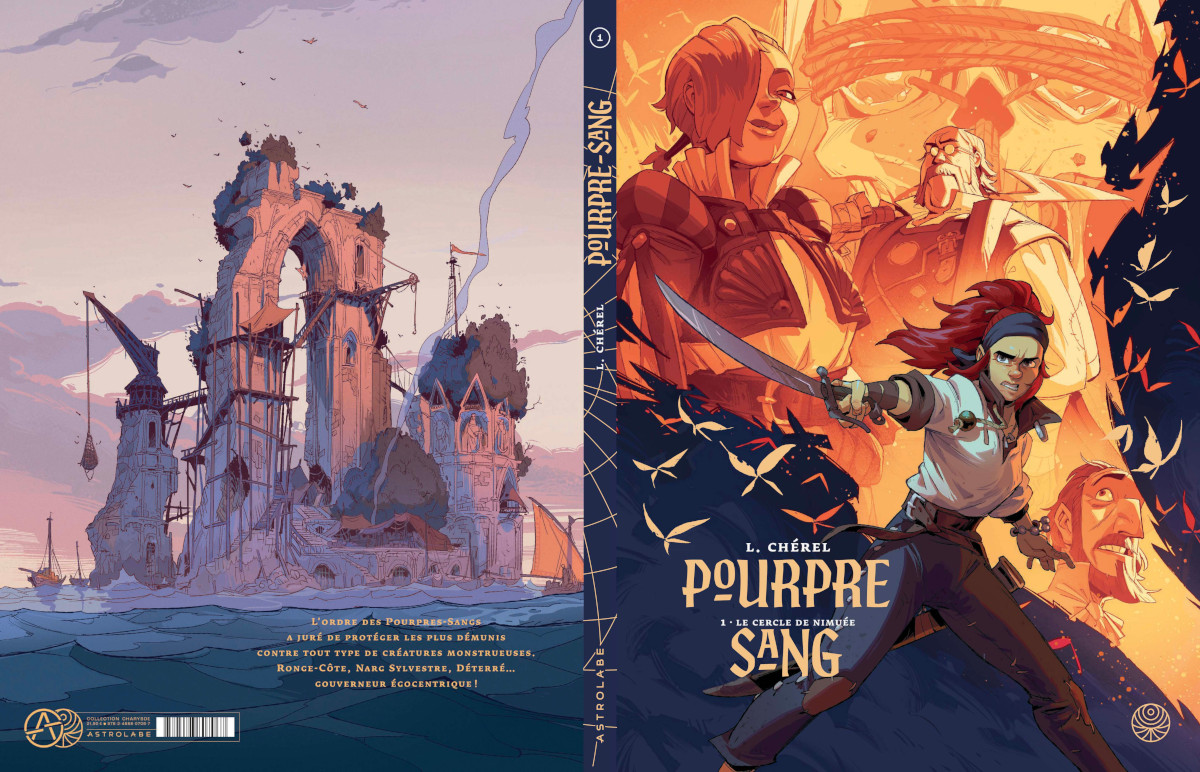
What I’ve learned recently is not to settle for a compromise too quickly, but to keep the conversation going until we find a solution that everyone can genuinely believe in. Pourpre-Sang, our first book released, taught me that lesson very early on. Léo Chérel (Pourpre-Sang’s creator) and I had completely different visions for the cover. I didn’t want to impose my taste on him, because it was his creation and his universe. And I certainly didn’t want him rolling his eyes every time he had to sign a copy. (laughs)
But I also had to think about the book as a publisher, with all the commercial and editorial considerations that come with that responsibility. The solution wasn’t to compromise for the sake of compromise. It was to keep working together until we found an idea that neither of us would have reached alone, and that we could both fully stand behind. Take a look at the bonus section of Pourpre-Sang and you’ll understand looking at the many attempts it took us to get the cover right. That’s what I’ve learned from creative collaboration so far. And I already know that’s just the tip of the iceberg.
It’s challenging, but it’s far more rewarding. The creator brings the story and the talent. My job is not to drive the project for them, but to sit in the passenger seat and help them understand the landscape, to bring them the culture of the industry. How the French market works, what readers expect, what the opportunities and limitations are, and how the business side of publishing operates.
If it’s their first comic, it’s about giving them tools they can carry throughout their career. We learn from each other. The goal is for everyone to understand the realities of the process, so we can build the best possible book together.
Another challenge is learning how to work with creators who may be twice your age. They’ve lived more, seen more, and often know far more than you do. In those moments, the relationship can’t be built on authority. It wouldn’t make sense, and it can’t nevertheless. It’s built on humility, mutual respect, and the understanding that both sides have something valuable to bring to the table.
That’s really the point. These aren’t strangers we suddenly approached with a project. They’re creators we’ve known, worked with, and supported for years. In some cases, we published their first books in France fifteen years ago. Sean (Murphy) and I have been discussing the idea of creating something together for years, and Astrolabe finally gave us the opportunity to make it happen. You’ll read about it in the bonus section of the French edition of The Last Driver, but Sean’s new series actually took shape during his visit to Le Mans, where we gave him a truly immersive introduction to racing culture.
When we decided to launch what would become Astrolabe, the first thing I did was reach out to the creators we had strong relationships with. If there was no history between us, I didn’t want to force it. That connection is essential. With new creators, the connection often comes from a different place. Many of them are reading Urban books, listening to our podcasts, or following what we’ve done over the years. They want us to bring that experience to their own creations.
One way or another, there’s almost always a link between us before we start working together.
subscribers only.
Learn more about what you get with a subscription