
“I Try to Never Do the Same Page Twice”: Artist Matías Bergara on His Art and A Mischief of Magpies
If I was tasked with creating a list of the most gifted comic artists operating today, Matías Bergara 5 would be on a shortlist of names near the top. There are very few who can create fully unique layouts, potent storytelling, powerful covers, and maybe best in the business commissions in the way Bergara can, and he proves it on every project he takes on. But while his name was elevated by his work on Absolute Wonder Woman with Kelly Thompson, the best showcase for Bergara are his collaborations with writer Si Spurrier 6 like Coda and Step by Bloody Step.
Those two clearly speak the same language in comics, and it results in some of the most gorgeous, spell-binding, and unique artwork you’ll find in single issue comics (to say nothing of what Spurrier brings to the equation). And now, after much ado, their latest collaboration has arrived in comic shops, as their DSTLRY series A Mischief of Magpies — which is about a troubled young man named Mar who keeps falling out of the real world into a fantastical one that needs him in a way reality rarely seems to — debuted a couple weeks back and brought some of the most…well, gorgeous, spell-binding, and unique artwork you’ll find in single issue comics (to say nothing of what Spurrier brings to the equation).
With that in mind, I thought it was finally time to talk to Bergara about what he brings to comics, so that’s what we did, as we sat down for an extensive art feature interview where the Uruguayan artist took me into his background as an artist and with comics, how he figured out his voice, pairing up with Spurrier, and more, before we break down some covers and pages from A Mischief of Magpies and talk about what went into each of them. It was a true pleasure to get taken inside the artist’s mind, as it’s clear he doesn’t just bring a unique approach to the work, but to the thought that goes into it.
You can read this interview in full below. It’s been edited for length and clarity.
Where did your love of art and, in particular, comic art begin?
Matías Bergara: In my childhood, like with most people. Some of my first reads were European comics. It’s what we used to get around here. Tintin, Asterix, and also local South American comics. Things for kids, illustrated books, all of that. It was pretty much like everyone else. Superhero comics also, especially the 80s DC stuff and some Marvel 80s things…here in Uruguay, we used to receive comics a bit later than the states. In-between translations and publishing and all that, we ended up getting 1986 books in 1990, so like four years later.
But those were the kinds of things that were around mewhen I was a little kid. I loved comic strips and animation as well, but differently from lots of my colleagues, when I was a little kid, I didn’t dream of doing comics for a living. I didn’t draw comics either. I just did like little silly drawings in my notebooks at school and stuff, but no more than that.
From what I understand, you didn’t start working in comics until you were 23 or 24. Not that that’s late, but I assume that you grew up drawing, like you did the pieces that you were talking about in your notebooks and stuff like that. But why were comics an appealing medium for your art, and what made you want to take the path towards drawing them for a living?
Bergara: It probably had a lot to do with the fact that in my late teens and early adulthood I discovered comics as a powerful narrative medium. Up until that time, I hadn’t really read comics seriously, but around that age I discovered some really cool graphic novels. I discovered Sandman and Watchmen, the works of Alan Moore, also Latin American graphic novels, the classics, (artist Alberto) Breccia, you name it.
Those are experiences that I only got as an adult, because I started making new friends when I was in my last year of high school and in my first year of college. I was very fortunate to make new friends who were really into comics, people who were actual collectors and readers. All those people started recommending things, like, you should read this. “If you like literature, you should be reading this and discovering this.” And they were right. It was amazing. After reading really great books, I started feeling like I wanted to make some of my own, even very distantly or vaguely, because I am not a writer.
I have never written anything, and I don’t have the urge to create with words. But I do have images in my head when I’m reading something or when something is inspiring. That was the stage of my life in which I started seriously considering comics. Not as a job, but as an activity I could do.
I imagine starting where you’re like, “I have to take this job because I need to pay the bills,” that might have given you a little bit of…I don’t want to say an easier path, but it might have allowed you to find your voice as an artist in a way that’s more passion driven rather than deadline driven.
Bergara: Well, I did not have the option to pick the easy or hard path toward comics. I only got the hard one. Back when I started, I barely spoke any English. That made international activities very difficult. My internet was lousy, and the internet was very poor in terms of available information back in 1999 to 2001. It was scarce. Also, I was in Latin America in a small country that had no publishing infrastructure for comics. There wasn’t a real tradition or business, so considering dedicating yourself to comics was pretty much like considering…I don’t know…like opening an ice cream stand in the North Pole. It was impossible. Nobody even thought about that.
The only distant notion of someone being able to live through comics was Eduardo Barreto, who did lots of comics for DC. He was a local artist, and he worked for DC in the ‘80s and early ‘90s mostly. He was pretty famous back then, but he was the only guy who had ever done it around here. So, for me, there was no other option than to explore comics as just a creative field rather than as a job opportunity. That came to me much later when I started having access to better internet and started traveling and learning a lot more and getting to know colleagues and other people.
I don’t know when I first became aware of your work. It might have been Coda. But one thing I always point to with your work is…you’re fantastic at everything. You have an extremely singular voice. But I think you’re the one person that Daniel Warren Johnson looks at and is envious when it comes to the commissions that you do. You’re so singular with your voice and it stands out on everything whether you do, whether it’s commissions or interiors. How long do you think it took you to figure out your voice as an artist?
Bergara: A long time. I’ve been doing comics professionally for almost 20 years now, or maybe a little longer, which means I’m not really new to this. I did Coda in 2018, so I could say I probably did comics for almost 15 years up until the moment in which I felt like I was seriously doing my own work in the way I wanted to do it. This was more of a personal journey than an editorial one. Nobody has ever told me to draw in a certain way or imposed specific limitations on me, but it was sort of like an internal process in which I did drawings for myself in a certain way and then I did professional comics work in a very different way.
It was very hard for me to bridge those activities, like getting to draw comics in the same way that I do drawings just for fun and for myself. To many colleagues, I guess this comes naturally. Most natural born artists do their thing and that’s what comes naturally to them. Like, I only know how to do my thing and that’s the thing that I do forever in my life.
For me, that was not really the process. I had a very slow learning curve of first learning how to draw correctly, then learning how to do comics, which was not natural for me, and then getting to like the language in a way that was pleasurable for me and effective for the reader.
I am very envious of the artists who right from the start know what they want to do. The guys and girls and everyone who from their teenage years know exactly what they want to do and have a very primal urge to draw and tell stories in a certain way. It was a long process. It wasn’t natural.
I started assimilating concepts and notions from many different places…from anime, from animated films, from early 20th century illustration, painting, photography, many, many different sources of things that I looked at. I like it and try to figure out why I like it and then try to take some of that for my art. I’ve discovered things that work for me mentally and some of the things that I’ve incorporated to my style I have learned through trying new tools, and different things come and go.
I think it’s interesting that the moment you found your voice was working on Coda because that was the first project you did with Si Spurrier, and A Mischief of Magpies is your fifth project together now, at least as far as we know. What is it about you and Si that works so well together?
Bergara: It’s difficult to explain. It was just immediate chemistry. We didn’t know each other before Coda, and we were presented to each other through mutual editor Eric Harburn who has been editing our books ever since and is a friend of ours. When I first read the first treatment for Coda, there were no pages or designs done previously. The script had passed through two or three different artists I think who had declined the story at different moments. I was like the third or fourth in line.
I found the treatment fabulous. It was rich with images and humorous and witty and very sophisticated. I liked it instantly. I think Simon and I also share a similar sense of humor, and we have consumed similar types of cultural objects and references. We don’t have to explain very much to each other. We understand comics in a very similar way so the work between us has always been very smooth, and it gets better with each project we do.
Nowadays, we barely discuss the work. It’s like Simon comes and proposes an idea and my brain immediately starts projecting images. Immediately. That’s how I work. I just have the script in front of me and I don’t need explanations. I know what’s going to work, and I know how to complement the story and how to challenge the story. How to expand the limits that already exist in the story.
This is a very important thing because I believe the role of the artist, as has been told many times, is not to just follow a script but help to expand it. In that sense, I feel like my work is always that of an interpreter in a certain way. I have to interpret the needs of a story, the character of a story, the mood of a story. And then I have to take decisions on how to make that work as best as possible.
Sometimes, some of the ideas that Simon has do not need any work. They are perfect and need nothing else. And sometimes I can visualize a different approach that will maybe work better than the original idea that Simon had. And at that point, it’s my duty to challenge the story and to challenge the characters and the structure and find out if there is a better or a more impactful way to do something.
In my experience, it always benefits the story.
I believe it. I’ve read your books.
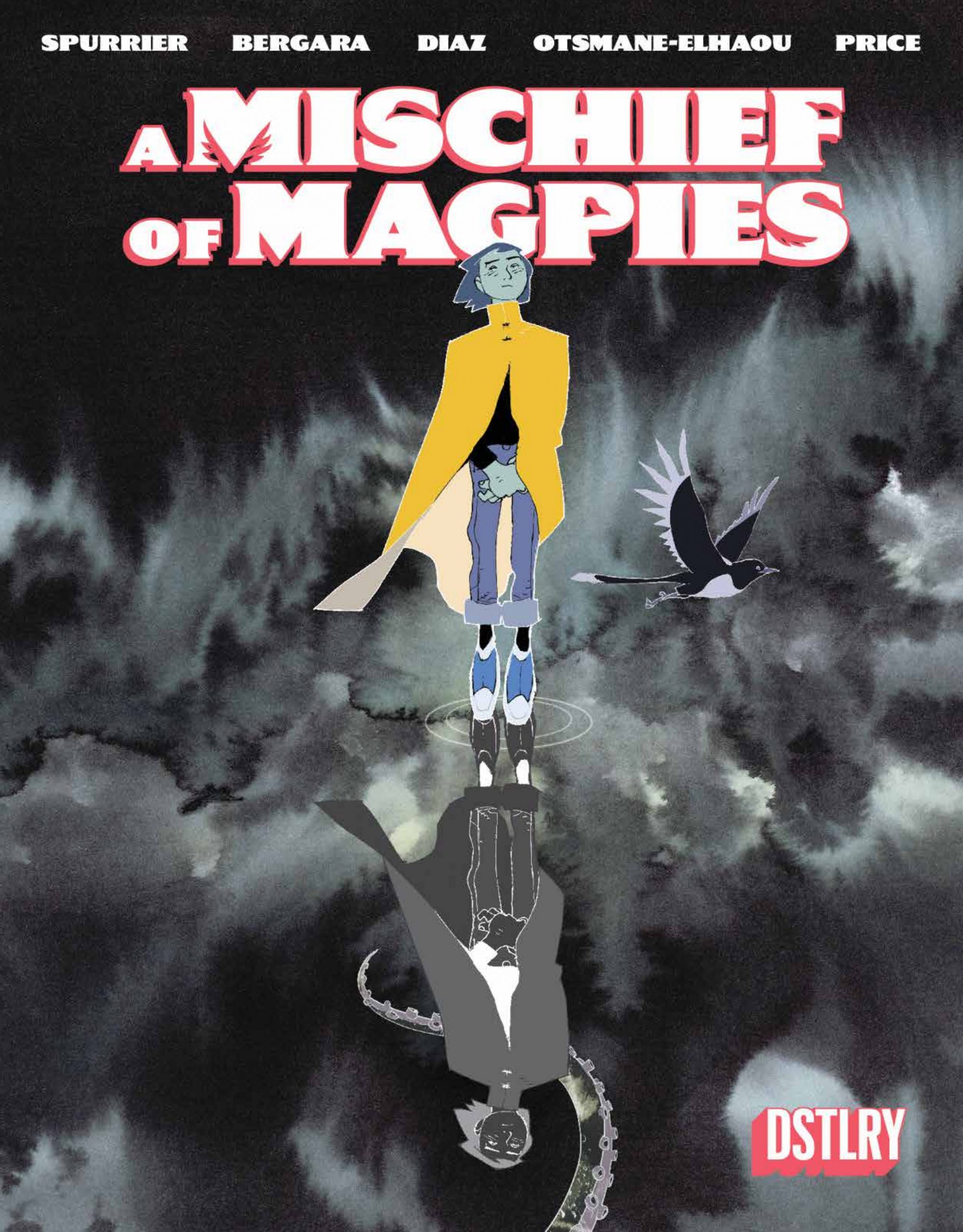
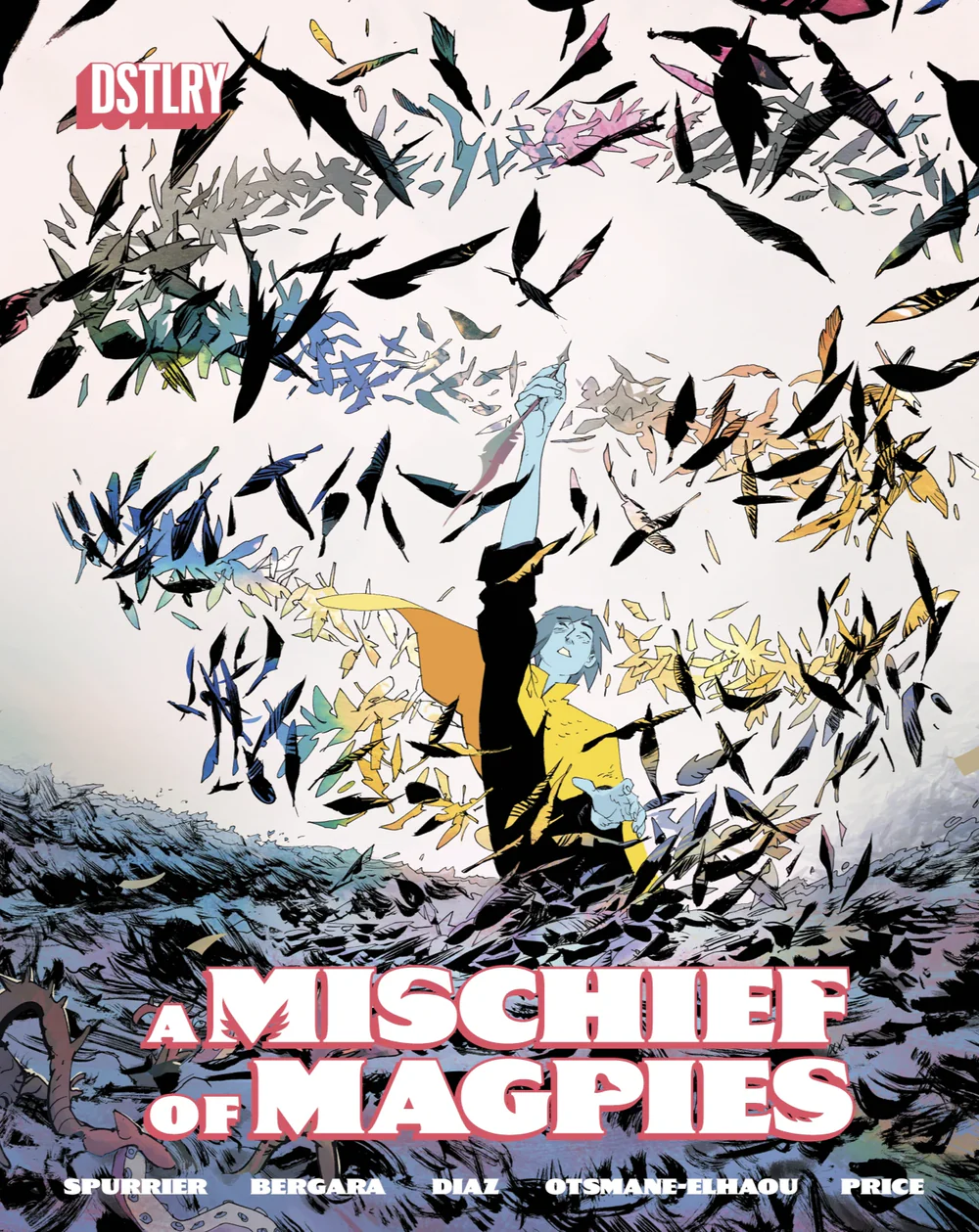
So, this is you’re a cover to A Mischief of Magpies #1. I want to ask about covers to start with because it’s the first thing we see, but also, I think every artist has a slightly different view of covers. What makes a good cover in your mind, and why was this the right approach for the first issue of A Mischief of Magpies?
Bergara: Some of the things are easy to explain and some others might not be as easy, but my general notion for comic book covers or book covers in general is that they should be graphically interesting, they should catch your eye first and foremost, and they should give you some information about what’s inside or what’s the tone of the story, of course. You cannot have a cover that has a strong dissonance to what’s inside the book. It should somewhat look like what’s inside the book. But most of all, it should be a good image, something that catches your eyes, something that brings questions to your head, something that moves you closer to the book when you see it.
I like the idea of a cover as an image that should catch your eye even from a great distance. Something that should be clear enough to be different and appealing even if you’re seeing it from a great distance, like half a block away, you should see something in the distance and ask yourself, “What’s that? I want to know what that is. I want to get closer and see what that is.” If you get to that, you have a successful cover.
And then, in the specific case of this cover, it was complicated because the story itself is not a very literal one. It’s not an obvious story. It’s not a very linear story. So, my approach to the covers of A Mischief of Magpies was that I should try to experiment graphically and I should try to not be too obvious with what I was presenting.
In this case, I had the idea of putting a lot of attention on Mar’s yellow cape, which is a detail I also use in the pages inside the book. But also, I wanted to create this sort of weird, experimental background for what you see here in the cover. I wanted to create something that was a strange effect that was not completely easy to unravel. It shouldn’t be easy to find out how I made it. That’s something I wanted. You take a look at it and you don’t know if it’s Photoshop editing, if it’s a painting, if it’s a filter, if it’s something else or a mix of those things. And I wanted it to be a mystery, like other effects in the story.
It’s kind of reminiscent of water, of clouds, of a dark place, something not entirely clear.
I mentioned earlier that you are a master of commissions. I love your commissions so much. But commissions and covers are both, by nature, a singular image that should stand out, should pop, and should at times tell a story. Do you have a similar mindset for covers as you do commissions, or do you see them as different beasts?
Bergara: Yeah, in the same way as commissions or illustrations or even pinups of characters, I always try to inject some sort of situation. There has to be something going on. You cannot just have a big face of a character standing in a place or a big shot of a head or a face. You can always do that because it goes for great effect, but you have to put a little something to make it more interesting or to make the image have a little bit more substance rather than just a cool image or a cool execution of colors or lines.
I think the worst thing you can do with a comic book cover is to try to make it like a panel in the same way the art that goes inside. Covers should give a little bit of information, but it should also give a lot of graphical richness and elaboration on that sense. Not just tell a story, but it always has to have something going on.
In the case of commissions, I almost always try to inject some action into it. If it’s a commission of two characters, my first question is, what are those two characters doing? They cannot just be standing on an empty space, or where one just stands next to the other. Who are they? Do they collaborate? Are they enemies? Are they fighting? Are they part of something? Where are they?
That’s a great question too, because someone that commissions you always is thinking of characters. But they very rarely think of where they are or what they are doing. That’s a question that comes to my mind a lot, and the same goes for covers.
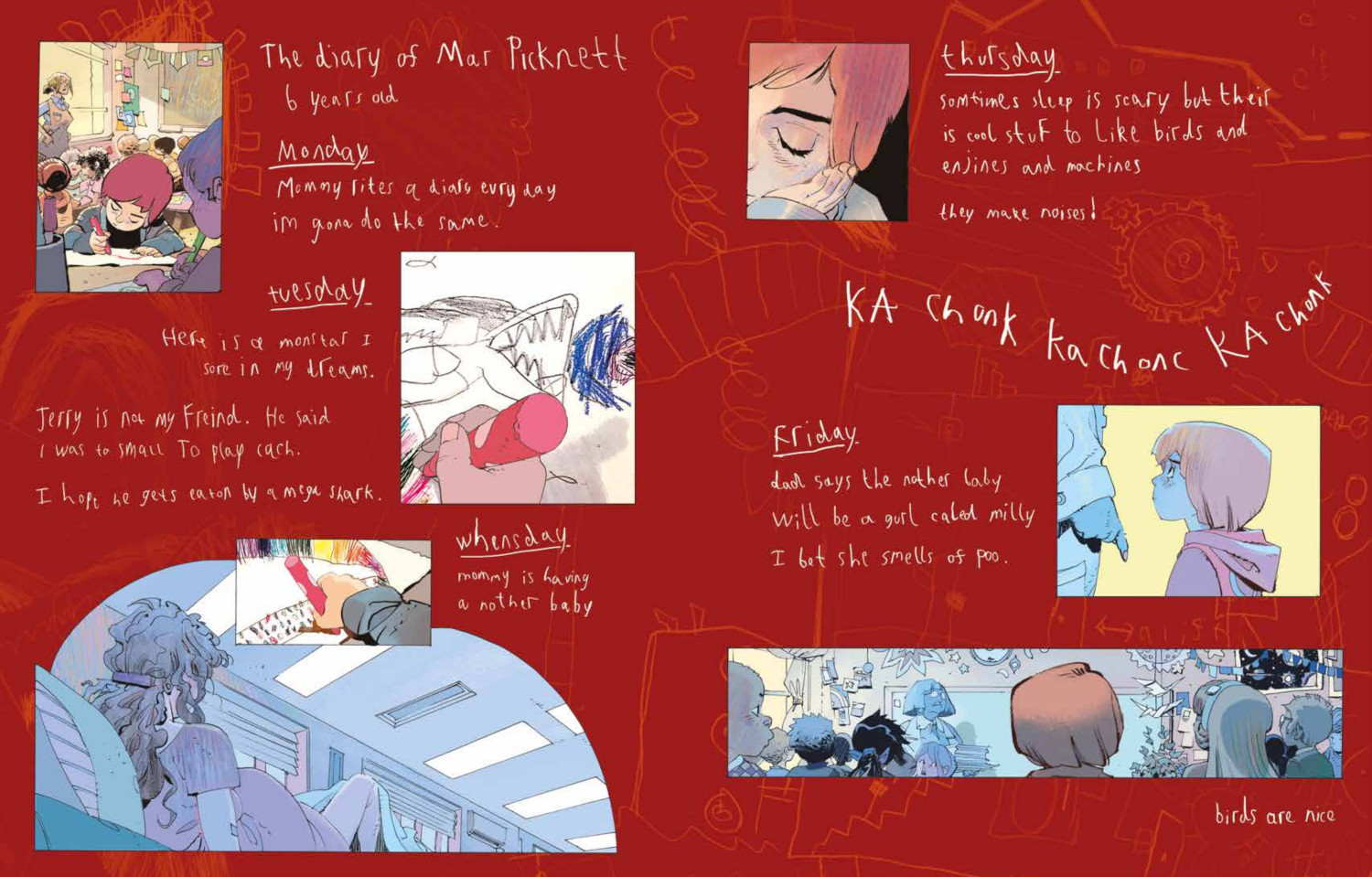
An interesting thing about A Mischief of Magpies is that there are these spreads throughout that are snapshots of Mar’s life built in and around his journaling. You’re getting to know the character through the way he journals about his life. While it gets more refined as he ages…as in he goes from writing it by hand to using a computer, the structure stays largely the same. How did you figure out the right approach to these types of pages to maximize clarity, but also to make them feel as dynamic as you can possibly get?
Bergara: This was the result of teamwork. In this case, we all worked together. Me, Simon, Emma (Price) doing the designs and Hassan (Otsmane-Elhaou) doing the lettering. We had to decide beforehand the layouts for each page…the elements you see here, what are the panels, what do they contain, and where the text is going to be, what the background is going to be., what the words will be and how all of that will be put together. This was a decision that we made beforehand.
For these specific spreads or pages, they are more convoluted and more complicated. Structurally, we had to decide early on how they were going to be. It’s not entirely my making. I decided the panels, of course. I chose how to do them. But the distribution of them was a collective effort. I just let Hassan and Emma move things around. I did the panels. I put them in a…I laid them out on top of a big file and then let everyone else do their job and make decisions as well.
In that sense, what you see here is 50% my choice and the rest is something that the rest of the team did.
subscribers only.
Learn more about what you get with a subscription
Pronounced Muh-tee-us Bur-gahr-uh for those who are curious.↩
Who is largely referred to as “Simon” from this point on.↩
Pronounced Muh-tee-us Bur-gahr-uh for those who are curious.↩
Who is largely referred to as “Simon” from this point on.↩
Pronounced Muh-tee-us Bur-gahr-uh for those who are curious.↩
Who is largely referred to as “Simon” from this point on.↩