
The Moment with Kieron Gillen
Welcome to The Moment, a new video interview series on SKTCHD with a simple premise: Creators join me to talk about The Moment they knew four of their biggest projects were going to work, whether that’s creatively, commercially, or some mix of both. It’s an easy idea, but the hope was it would act as a jump off into something far more complex and interesting.
The hopes were fulfilled in the first episode, as writer Kieron Gillen joins to share the moment he knew four comics from his career — each of which I picked — were going to work. Those comics were:
- Journey into Mystery, with Stephanie Hans, Doug Braithwaite, Pasqual Ferry, and more
- The Wicked + The Divine, with Jamie McKelvie, Matt Wilson, and Clayton Cowles
- Darth Vader, with Salvador Larroca, Edgar Delgado, and Joe Caramagna
- Die, with Stephanie Hans and Clayton Cowles
Gillen takes viewers inside that moment, exploring when he realized these comics were going to work as well as they did, before I ask one follow-up question for each. It’s a very good time, with great insight from Gillen as he talks about these amazing comics.
You can watch it here or on YouTube. Oh, and while you’re at it, make sure to subscribe to the SKTCHD YouTube channel, which will be getting Shorts posted from this episode throughout the week and more in the future. Also, the goal for this is to be a monthly series, and with my guest for the next episode already booked, we’re in good shape for that. So, stay tuned for more of The Moment!
Want to start reading Gillen’s comics that we talk about here? Make sure to check your local comic shop first, but if you can’t find them, here are some places where you can get started on these excellent comics.
- Journey into Mystery (the first Epic Collection)
- The Wicked + The Divine Compendium
- Darth Vader (the first Epic Collection)
- Die Vol. 1
Now, I know some folks don’t want to watch video. That I totally understand. I’m not a big YouTube watcher myself. and for you fine folks, I have a solution. Thanks to several requests, I’ve now decided to add a transcription of each of these chats for The Moment at the bottom of where I post the video. That way, folks have a chance to read it instead if they’d prefer. So, here’s that chat with Kieron Gillen, but now in written form, although it has been edited slightly for length and clarity. Enjoy!
Welcome to The Moment, an interview series on SKTCHD that finds creators joining me to talk about The Moment they knew some of their biggest projects were really going to work, whether that’s creatively, commercially, or some mix of both. I’m here with Kieron Gillen, my first victim. Are you ready for this, Kieron?
Kieron Gillen: Not really. I live in a world of amusements. I’m really not ready for anything. (laughs)
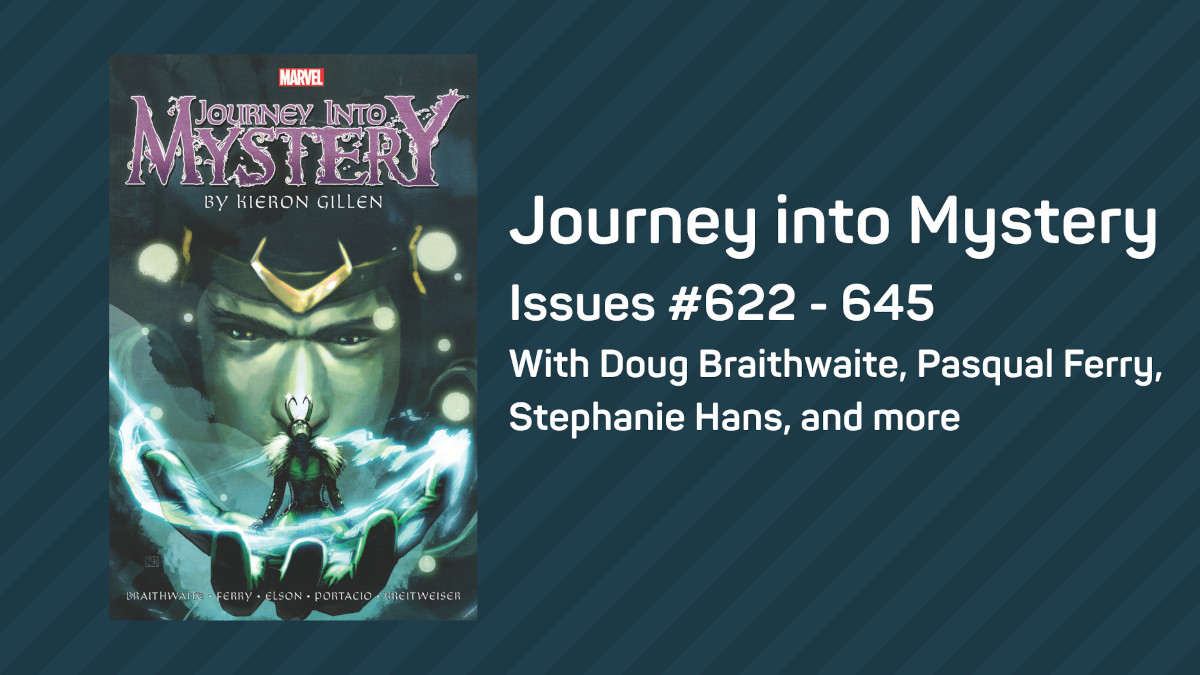
Let’s get into the first book. It’s Journey into Mystery, one of your earlier Marvel projects, and it brought you together with your eventual Die collaborator, Stephanie Hans, for the first time, amongst other artists like Doug Braithwaite and Pasqual Ferry. It was really fun looking back through the artists that worked on the book. I forgot about some of them.
Kieron, what was The Moment that helped you realize that that book was going to work?
Gillen: Well, this is an interesting question for all of them. With Journey into Mystery, I’m going to choose one that’s quite late.
I came to Journey into Mystery wanting to do something that was good. And that sounds like a weird way of putting it. But I was doing Uncanny X-Men, which was a book to prove that I wasn’t a complete weirdo. And Journey into Mystery was, no this one’s for me. I’m going to try to make people buy a book that’s about this complete weird stuff. We’re trying to tie into all these crossovers and make it work.
I had this big sort of plan of how it would lay out. And I explained it to my editor, Lauren Sankovitch, who took over what was going on in book. I said that basically there’s this character called Leah, we’re going to do something terrible to her in issue 18, and if we do it right, there won’t be a dry eye in the house. You can hear my cackle there.
We hit issue 18. It was a book that was always popular on the internet. It really had a very intense fandom. It hit issue 18, and my god, weeping tears, gnashing teeth, just lots of screaming, instant fan art of trying to redo the wrong.
I sort of just wandered into the next room to tell my wife. “The internet’s really crying. They’re very upset.” “And do you feel good?” And it was like…no, I feel terrible. I didn’t enjoy it at all. But it worked. That was the first big beat where I was like, oh yeah, now the entire end game’s fine, because that’s the first bit which proves the plan is working.
And that’s where it counts.
You’re a writer who has become famous for hitting readers in the feels, as they say. I would argue that Journey into Mystery was the first time that happened in a major way in your Marvel work. Would you say that’s the case? Would you say that’s the first time you were like, I can hit these types of readers with big emotional beats and it’s going to resonate?
Gillen: Yeah. The interesting thing about Journey into Mystery was I was forced into writing a character who was more emotionally open. The idea of Kid Loki was Matt Fraction’s idea. I presumed we’d get rid of it in like six issues or something. But no, we’re going to stick with it. I wasn’t sure. Then I started writing it, and it was, my God, Fraction, this is a brilliant. Because what it forced me to do was write a character who was as smart and manipulative and clever and like all the good stuff my characters regularly are but also a 13-year-old. So, everything was heightened. Everything was closest to the surface. It gave me permission to show feeling as opposed to being very British and not.
That changed everything in terms of like, oh no, I can now see this, and it’ll allow me to approach the work in different ways and being more visible rather than my tendency to have characters whose masks crack, which I still do quite a lot. And then it’s quite moving when you’ve got someone who’s like very icy then cracks, but I also can not do that.
So yeah, absolutely. It taught me more than any single book I’ve ever done in my career, I think.
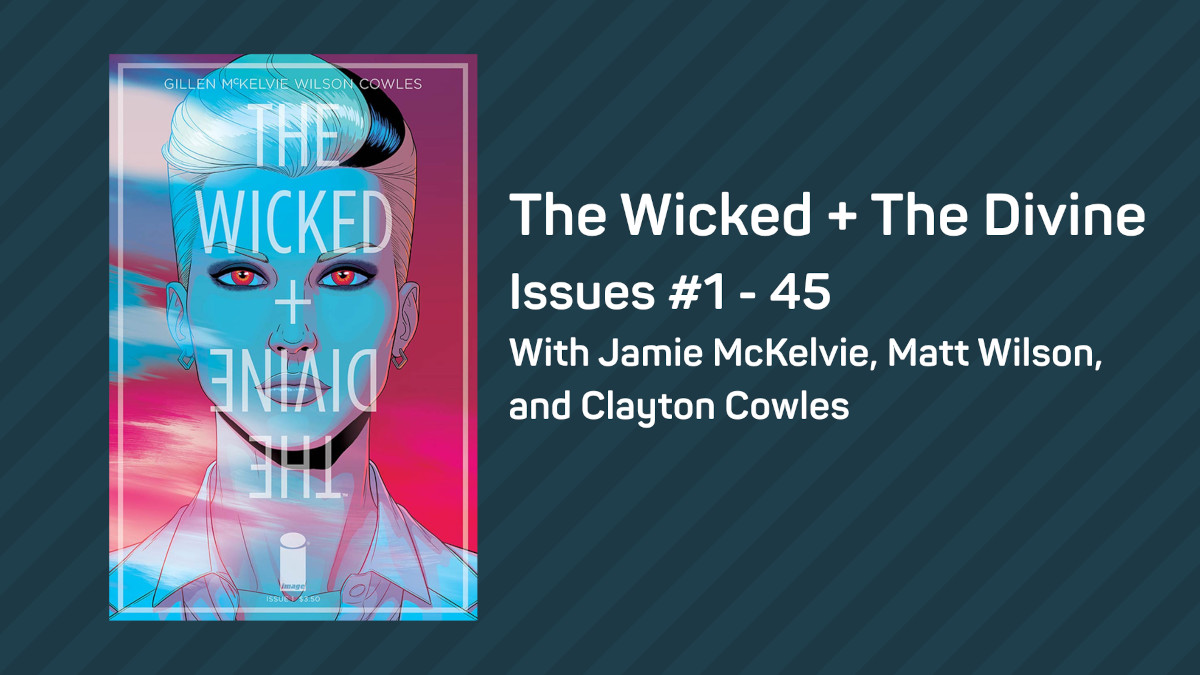
Up next is The Wicked + The Divine. It’s your Image Comics series with artists Jamie McKelvie, colorist Matt Wilson, and letterer Clayton Cowles. What was the moment that helped you realize this one was going to work?
Gillen: Okay, this is completely the other end of the process. We’d come off like, which is our kind of breakthrough weird indie work that people got tattoos about. We did Young Avengers, this kind of “hit book,” and kind of a “hip, cool book” during Marvel Now. But it had a vibe. It had big cosplay. That’s the other reason you knew Journey into Mystery worked.
Me and Jamie just wanted to launch an actual book. Because in terms of an indie book that would sell enough to allow us to do the Vertigo length 50 issue series, and we desperately wanted to do that. That’s kind of why we came into comics. And our generation of writers and artists just didn’t get to do it, exception Jason Aaron. So, it’s our one shot.
We were in the Southbank Centre in London. I was with Jamie, and we sort of separated and we’re heading somewhere else. And I looked at my phone and got the message from Image that our orders are just coming in at 55,000. And I could’ve been like, (makes a shocked, overwhelmed sound). And I’ve got to run all the way back down to tell Jamie.
We immediately thrown a party that night. We went to a party in the pub nearby and it was just our friends down. It’s also a great launch. We’re very happy with it. But the basic mathematics meant if we don’t mess this up, we could do that. The math of the 55k and doing it with the level of regularity and quality we thought we could do. We could do (the full-length plan). Suddenly you could see this could work as opposed to if you launch it 20k, it’s not going to work. It’d be very difficult to hit 50 (issues). We had everything to play for.
So yeah, that was the magical moment for WicDiv.
It’s one thing to launch at 55k and it’s another thing to build a community like you did. Have you ever experienced or do think you’ll ever experience again anything like the community that formed around that book?
Gillen: I do pretty well with communities in a broad sense. But WicDiv If was a phenomenon. I can see it on the graphs of the sales and how it happened. I could have chosen multiple times on WicDiv. Maybe I knew it was going to work when we saw the first person getting a tattoo of WicDiv before it came out. Maybe we knew we it would work at any of the weird parties we threw.
I always remember Mike Conrad at one of the last WicDiv parties in Seattle. It was a beautiful venue; it was like a church. We had to stop people having sex backstage at various points. (David laughs) It was a genuinely exciting point and he said, “(Grant) Morrison in the 90s was writing about these scenes, and you have created a place where I’ve seen this happening.” And us being influenced by The Invisibles made that feel like the whole thing comes circle.
That was not a moment when I knew it was going to work. That’s the moment when I knew it had worked. I don’t think it will probably ever happen, but The Power Fantasy has a fanzine. It has two fanzines out by issue 11. But that’s kind of born of WicDiv readers, as in people who have embedded in that.
But yeah, I doubt we’ll ever have anything else like that. Our life is over. (laughs)
I’m sorry, I’ve killed you in the moment. (laughs)
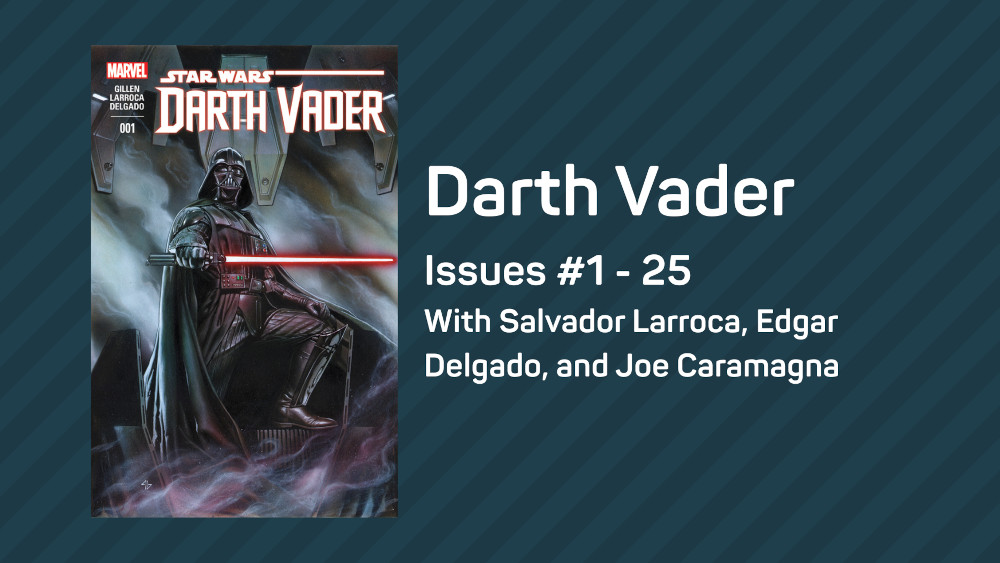
Our third book is a curveball. It’s Darth Vader, one that I really love. I rep very hard for this book. It’s where you told the story of what our guy Vader was up to between Star Wars and Empire Strikes Back, and you did that with Salvador Larroca drawing every issue. Actually, I do want to note, every single creator on that book was on every single issue, which is bizarre and weird for a 25-issue book from the last 15 years.
What was the moment where you realized this one was going to work?
Gillen: This is a trickier one in that, was I ever sure it was going to work? But I’ll tell you that what I think comes down to. I always think about the first trip we did to Lucasfilm. It was me, Jason Aaron, Axel (Alonso), Jordan White, and John Cassaday. I’d never met John before, and we went there and were in the pub the previous night before we met with Lucasfilm. We just chewed it over.
We were talking about how we wanted to do Star Wars on comics. Not just do a Star Wars style comic, do Star Wars on paper, not use the conventions of the comic book, use a lot of like how we frame stuff, how we chose to present things. Like, imagine if we’re having the screen. And especially when John was talking about it with such obvious passion. I could say that. That’d be a cool moment. I don’t think it was that for me.
It could have been going around Lucasfilm the next day and us being entirely enchanted by finding Princess Leia’s bikini and working out what it was. We thought it was a knee guard because it’s that small. (David laughs) Or the moment I was standing in front of a statue of Harrison Ford in Indiana Jones and thought, “Hmm. Rogue archaeologist. That could work, couldn’t it?” (laughs)
But I think it was later. It was issue three of Darth Vader when Vader met Aphra. Aphra was on the cover, that issue went big, it reprinted a lot. And this is the moment when we introduced a character who was not a Star Wars character. That felt like heresy, the idea of writing a character and making them stand next to Darth Vader and hang out just felt wrong. I just didn’t believe it.
And people bought it.
The second when people bought Aphra and the droids in the context of Vader and eventually Leia and Luke and everyone else, that was it. The moment that, I can tell this story because my parts are now working as part of the Star Wars universe. They were accepted. And they are still accepted now, which is nice.
One of the things that’s interesting about your run, is while you exist between two immovable points in Star Wars and Empire Strikes Back, you somehow found a way to introduce a lot of different things and characters that have resonated for long time, to the point where, Black Krrsantan, the Wookiee, ended up showing up in the Book of Boba Fett. That’s an interesting thing.
I think that licensed books like that aren’t materially different from for hire superhero work in the sense you’re always playing in somebody else’s universe. But did you go in thinking in the back of your head that, whatever I do could impact the rest of this universe? Or is that something you don’t even think of going in?
Gillen: It’s funny. It’s almost the other way round in that since it was starting from a clear canon again. When they offered me the job, I had really thought about whether I wanted to this job. Because only one person gets to do this story. Only one person gets to do the link between Vader there and here. You get to dig into the emotional reality of it, because there’s significant things that happen for Vader. In some ways, I had an easier job than Jason did, in that Vader learns the last 20 years of his life had been a lie. That’s not small. And he also recovers his status after the Death Star by implication.
These are real meaty stuff you can do to hang a series off. I was worried I was the right person for the job and somewhat arrogantly I thought about it and realized, of the people currently working for Marvel, you probably are the best choice. You’re the person who writes villains. There were lots of other reasons, and you can do it. So, I was much more worried about doing justice to the opportunity the job had. That was my main worry.
I did almost a historical job. The idea I knew the end point and the start point, what is the logical thing to connect these two in the most dramatic way possible? It was like playing the blues and yet I know how Star Wars goes. I’m going to do something simpatico with that. It was worryingly natural. That’s the actual thing that most scared for a story that could have been, and basically since Empire was the first movie I ever saw in the cinema, I’m writing my own entry into geek culture in a Morrisonian way. This is a loop in time.
It turned out to be the most natural thing in the world, like Luke using the force to shoot the Death Star. It just happened.
Look at that. Metaphors. (laughs)
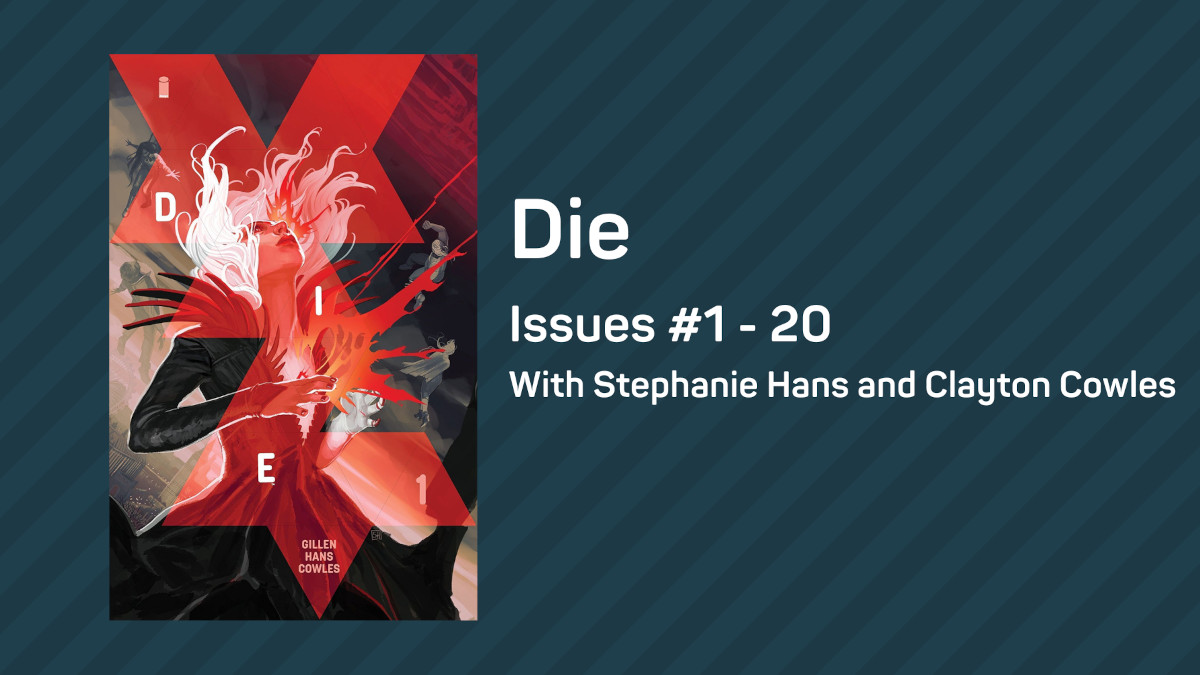
Lastly, we have Die, your Image Comics series with artist Stephanie Hans and Clayton Cowles What was the moment where you realized this series was going to work?
Gillen: I think part of me goes; I knew it instantly. I had the idea and was like, this will sing. And it came when I was joking with Ray Fawkes and Jamie McKelvie in a San Diego clothes shop eating ice creams talking about the (Dungeons & Dragons) kids. Whatever happened to them? They would have to be 40 by now. That nagged at me, and then it clicked why the idea was nagging at me that evening. The idea that maybe I lost myself in a fantasy world at the age of 16 and never came out. How did that hurt me? How did it hurt everyone around me?
There’s so much stuff there. And of course, I burst into tears because I always do. And instantly the idea of, you do an adult story about the juxtaposition between child fantasies, adult realities, what is lost, what is found, all that stuff. It’s such a very clear, pure plot drive that it will work. That’s one answer.
The other one is a bit more…that was the Die in theory. Die in practice, it became much weirder instantly. I wanted to write a clear character drama. It became this big sprawling history of RPGs and an RPG system off the side and everything else. So, what clicked there, I was developing both at once. There was a period I didn’t know which was the lead project as in, was I doing an RPG and then doing a game of it or vice versa? And they eventually became an ouroboros and sort of ate each other and became one thing.
One of the moments they did that was I was I had invented The Fallen, who were one of the iconic villains in Die. I had a few ideas where they came from. And in the game, I butted into a problem that this system is deliberately deadly. People die very quickly, but character death in RPGs is rubbish. You don’t want to get people wiped out. And I sort of realized, wait a sec, how about they get up as essentially zombies and if they eat another player, they become alive.
Die is about that very hard question of what you will do to get what you want. And then suddenly by solving the problem of player removal, player elimination from the game and creating a much more dramatic end game, I’ve also created an interesting situation in the comic because all The Fallen they meet are dead people. So, I had fallen in the comic as planned early on before I realized the true name of it. And of course they’re called fallen anyway. There are bits of Die you feel. They’re called fallen. I already put it there. That’s the bit where I knew it was working. As these two things where it’s speaking to a larger whole and integrating really beautifully.
Die was a berserk Katamari of nerd stuff coming together and just rolling on. I’m still shocked it worked.
Alternative one. When Stephanie’s first issues cover came in. It was an instant classic. That was where I was like, “Oh, we’ll be fine. Stephanie’s got me.”
There are a lot of times where the first cover is the one where I’m like, I have to pick up this book. Which is the job of the cover, right? It’s a marketing piece, at least in part.
Die isn’t just a comic but a role-playing game, something that’s only expanding with the upcoming Die: Loaded at Image. Did putting that series and its accompanying parts together expand your vision of what you could do with comic projects at all?
Gillen: It was more vice versa, I think. The reason why the RPG exists…my friend, Leigh Alexander, who we did the WicDiv issue where I basically role played online with a bunch of journalists, and they wrote up the story. It was a very big, complicated project. And Leigh said, your work is most interesting when you use stuff that only you do. In other words, it’s reliant on my skill set, which I picked up from being a journalist, from playing online games back in the 90s, all these kinds of things, which maybe not many people have.
That’s where the RPG came from.
The idea that most people don’t do this, so do it. Die feels like the answer to the call to action rather than vice versa. But it certainly taught me that it could be that, as in my instincts were right, that this is a thing that one could do. And yeah, there’s so much about like comics being a very pure subculture where we can get away with things. I think that’s what’s most exciting about it, as in why not do that?
That’s what makes me excited. And if you go all the way back to the beginning my career, where I deliberately chose Phonogram over another book as my first comic, because Phonogram was, if I only get to do one comic ever, it’s that. And I think doing stuff only you would have any interest in doing is a really good magnetic north as a creator. Which sounds very hippie-like, but it’s also useful. Because if I died after doing Rue Britannia, I’d be happy, because many people go their entire career without doing a work as personal as Rue Britannia was.
Everything past that was gravy.