
So, Your Comic Has Become a Speculator Hit
What’s it really like when your comic becomes a target for speculators?
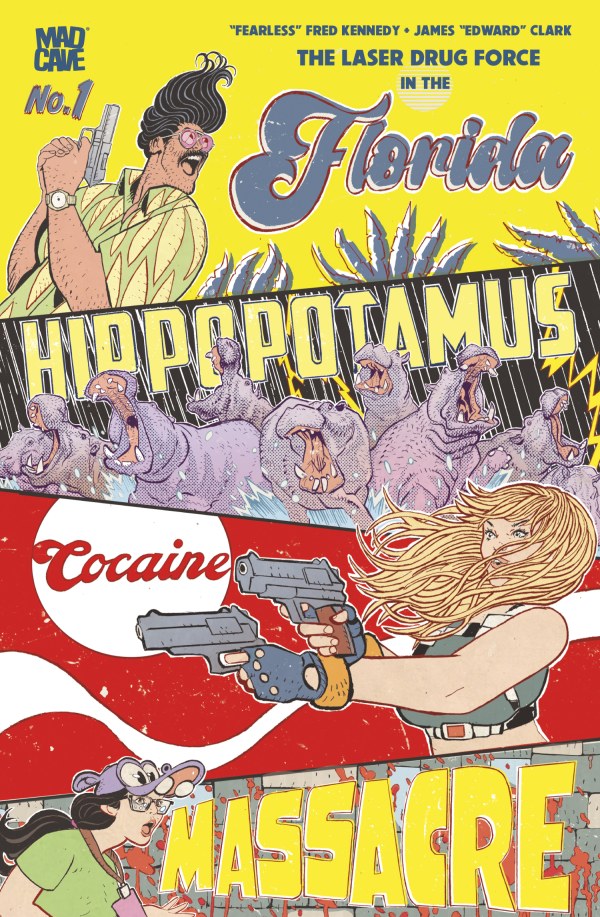
Writer Fred Kennedy is no stranger to the world of comics. He’s written titles like Dead Romans at Image, The Fourth Planet at Chapterhouse, and worked on an array of licenses like Overwatch, Diablo, and Assassin’s Creed, amongst others. So, going into his new Mad Cave Studios series The Florida Hippopotamus Cocaine Massacre (FHCM), he probably had some idea of what awaited him.
Or at least he thought he did.
It started out fairly typical. The book came out and people discovered this sensationally named series from Kennedy and artist James Edward Clark, as they do with any comic. But then the Saturday after release arrived 10 and a retailer from Toronto’s Gotham Central Comics reached out with some unexpected news. It seemed that the comic was already selling for $100 online, something that confounded the writer despite his experience.
“I kept asking him what that meant,” Kennedy said. “He was like, ‘It means people like your book!’”
That same day, he did a signing with Clark at Gotham Central, and within half an hour, the shop was sold out despite ordering an extra 100 copies because of the event. It was like a swarm had descended upon the shop, and they were all desperate for more Florida Hippopotamus Cocaine Massacre.
“I suppose for some people that’s not the biggest of deals, but I’ve never experienced anything like that before,” Kennedy said.
“And it just kept going.”
That is, in part, the power of speculation, a word that has helped define the direct market’s year so far.
2026 has seen a wave of unexpected, unexplained speculator hits, which, for those that don’t know, are single issue comics that arrive on the scene and instantly become desirous collectables, items that are energetically purchased and perhaps even more enthusiastically resold at exorbitant prices online simply because they have the potential to be extremely valuable — thus, speculation.
From the time Brett Bean’s Image Comics series D’Orc debuted in early February to the arrival of Patrick Kindlon and EPHK’s Tigress Island 11 in mid-March, at least seven titles from a variety of publishers became targets — including FHCM — which led to rapid sell outs in comic shops and at the distributor level while auctions for ungraded copies hit triple digits, at times.
It was a torrid start to the year, and while its pace has seemingly slowed of late, it’s still been a huge part of the conversation surrounding the direct market. It was at the tip of everyone’s tongue at February’s annual conference for ComicsPRO, 12 as attendees had an array of questions about the subject. Why was it happening now? What’s fueling it? How sustainable is it? Where can they get more copies, and can they get more right now?
Those are all important questions, and some have answers that can be found by looking at the history of the direct market. All this has happened before and all this will happen again, as the law of supply and demand has fueled many an unexpected hit in the past when the former was low and the latter was high. But the questions that were repeatedly asked ignored the “Who?” of it all, and by that, I mean, what the heck does it feel like when your comic becomes the apple of the speculator eye? And how does that affect creators like Kennedy?
For all the conversation about this topic, that was something I hadn’t seen addressed in the hubbub about it, or at least I hadn’t until now. That’s because I reached out to a bevy of creators whose comics were part of this recent trend to learn what it feels like from the inside. While some of the response was roughly what I expected, with creators describing the sudden uptick in interest as “surreal” and “confusing,” what I learned from these creators surprised me.
In my mind, there was going to be a specific flavor of response, a complicated one driven by the fact that creators want people to both buy and read their comics, as speculators will certainly do the former but often not do the latter. But while there was some of that, what creators had to say was unexpected to the point it made me reassess what I thought I knew about this subject. But I guess I shouldn’t be too surprised.
As is often the case with the direct market, very little is as cut and dry as we might expect.
subscribers only.
Learn more about what you get with a subscription
This was February 28th.↩
Also an Image title.↩
The trade organization for direct market comic retailers.↩
These were the patient zeroes for this trend, and the creators involved (alongside Image itself) declined to participate in this article.↩
Maybe the best recent examples are Something is Killing the Children and Immortal Hulk, two huge speculator books that ended up becoming beloved ones for readers that sold well throughout their runs, with SiKtC still going strong.↩
It should be noted that these interviews took place before the release of the second issue for any of these titles.↩
Although he was even skeptical about that bit, ending that section with “…I guess?” Fair!↩
Who is tremendous at playing this game.↩
Hillyard, his artistic collaborator on Narco.↩
This was February 28th.↩
Also an Image title.↩
The trade organization for direct market comic retailers.↩