
Comics, Seriously: The Sentry Goes VJJJWOMMMVVVVVVB
A sound designer takes on one of the more notably weird sound effects from comic book history
In this edition of “Comics, Seriously,” my recurring column here on SKTCHD that takes weird moments from comic book history and looks at them in far too serious of a fashion, we’ll be looking at probably my favorite sound effect in comic book history. You see, I love sound effects – or SFX – in comics. They add a lot to comics when done well, and are often unintentionally hilarious when done, well, strangely.
And by far my favorite SFX in comic book history came from World War Hulk #5, with it either coming from writer Greg Pak, artist John Romita, Jr. or letterer Chris Elipoulous. It’s when The Sentry is squaring off against The Hulk, as the two heavyweights are trading blows right and left. The Sentry goes for a big hit of pure, insane John Romita, Jr. energy, and we’re given a piece of SFX that’s meant to represent this exchange. What was it?
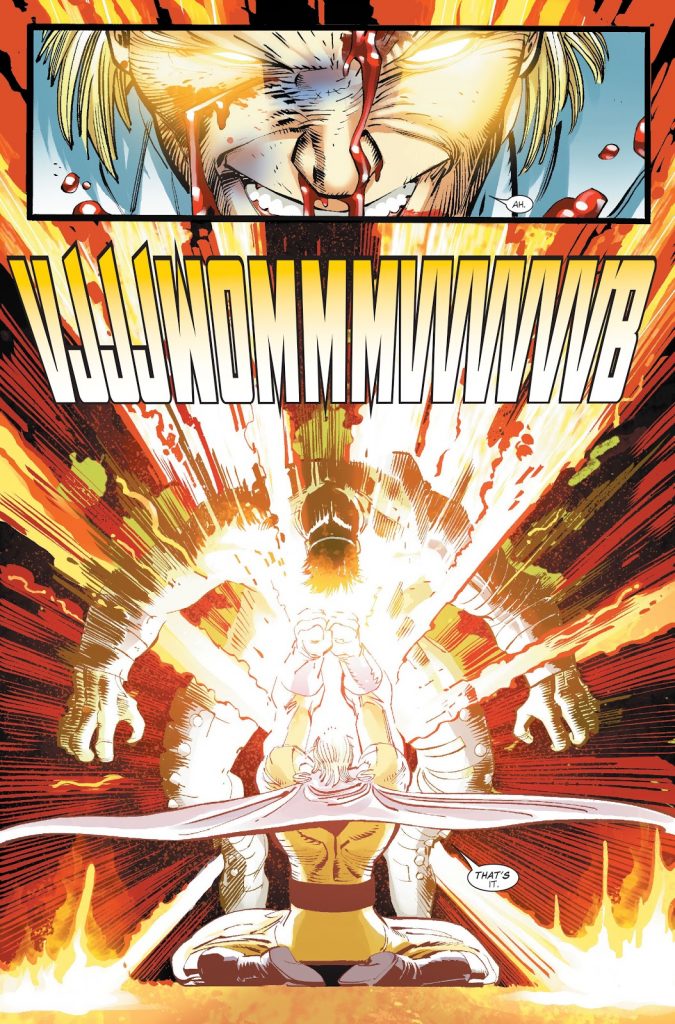
“VJJJWOMMMVVVVVVB” in big, glorious caps of doom. 1
For the longest time, I thought this was the funniest thing in the world. It made me laugh as soon as I saw it on the page, and it’s something I’ve talked with comic friends a fair bit about because of its absurdity. It’s just one of those big weird things in comics I love, if only because I always wondered, “What exactly would that sound like?”
So in this edition of Comics, Seriously, we’re going to answer that question. “How are we going to do that?” you might be wondering. It’s quite simple, really. I asked foley artist and sound designer Chris Szott (Blade Runner 2049, Hostiles, Vikings) to take on the challenge of interpreting this sound effect, and he did not disappoint in the slightest.
Here’s the funny thing, though. Szott did such a good job with it that it actually made me appreciate the sound effect more? It went from being a ridiculous thing to “Ohhhh! Okay. That makes sense now.” because of Szott’s interpretation. Part of me was disappointed because it wasn’t as funny as I hoped, but at the same time, I was happy to see a positive result come from the experience. So instead of our traditionally gag filled version of this column, you can find Szott’s sound design for this SFX below (note: Szott recommends using headphones when you listen, and I second that recommendation), and then an interview with him about what he came up with in the process.
As a Foley artist and sound designer, where do you normally start? What are you normally given when trying to interpret a specific sound for a project?
Chris Szott: When trying to interpret the sound of any project, I tend to start with trying to understand the context of the sound needed, and how that contributes to the story being told. Once I have a grasp on what is needed and why it is needed I can then start breaking down the sound in to the various layers required to create that sound.
When I am doing the Foley on a show or film, oftentimes I am given “spotting notes.” These are specific cues provided by the Supervising Sound Editor that point out what to cover (sometimes what not to cover) and any important details like “make the dishware and cups in this dinner scene sound expensive.”
When I am doing general sound design, often times I am provided a script (if it’s a theatrical play) or a visual component (in this case it was the image of the comic panel). Whatever my starting point for interpretation, the key is understanding why there needs to be a sound there. There is a quote from sound designer Mark Mangini that I try to keep in mind whenever I am working: “Great sound design starts with great storytelling. Why do we need a sound? instead of How do I make that sound?” Understanding how and why a sound can complement the storytelling is half the process and battle.
I have to ask…from a very base level, when you see “VJJJWOMMMVVVVVVB,” does that make sense as a sound to you? Because I have wondered for a long time what the heck that was.
CS: I’ll be the first to admit that my knowledge of anything comic related is very limited. I can’t say I have read many comics or graphic novels or seen many of the modern superhero films (even though I have heard they sound fantastic!). When I first saw the text “VJJJWOMMMVVVVVVB” my gut instinct was that this had something to do with an enormous release of energy – a nuclear weapon even. So although linguistically the word didn’t really make sense to me, instinctively it did.
With this, what was your process for figuring out the “VJJJWOMMMVVVVVVB” sound effect and connecting it with the action on the page?
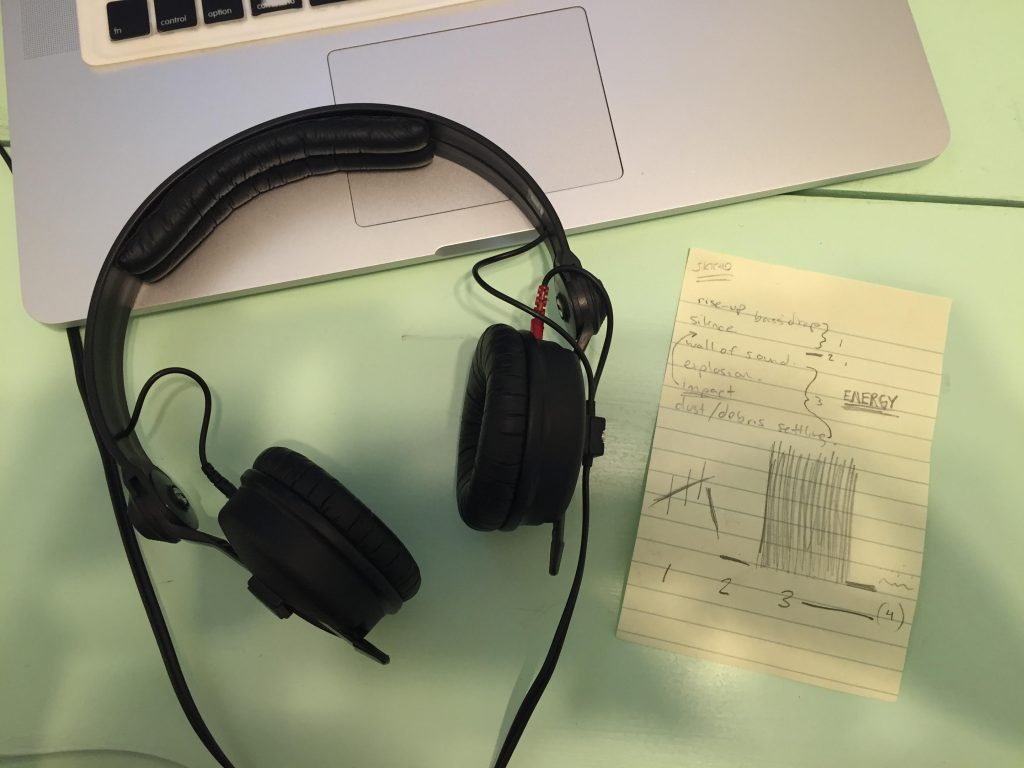
CS: Like I mentioned earlier, I instinctively felt that this image was a very high-energy moment that required several parts to convey that energy and emotion. I wrote down some of the first ideas that came to mind when looking at the image, like “energy”, “wall of sound” and “debris”, and actually sketched out my initial thoughts in to a ‘graphic composition’ to guide me during my process. To me, the action on the page was conveying three “actions” – the build-up, the strike, and the resulting impact. From there it was experimenting with various sounds in my library to come up with the necessary parts to achieve the overall sound of each part.
To clarify, if you didn’t before, what are the sounds we get in the audio file, and what made each of them important to include in the sound?
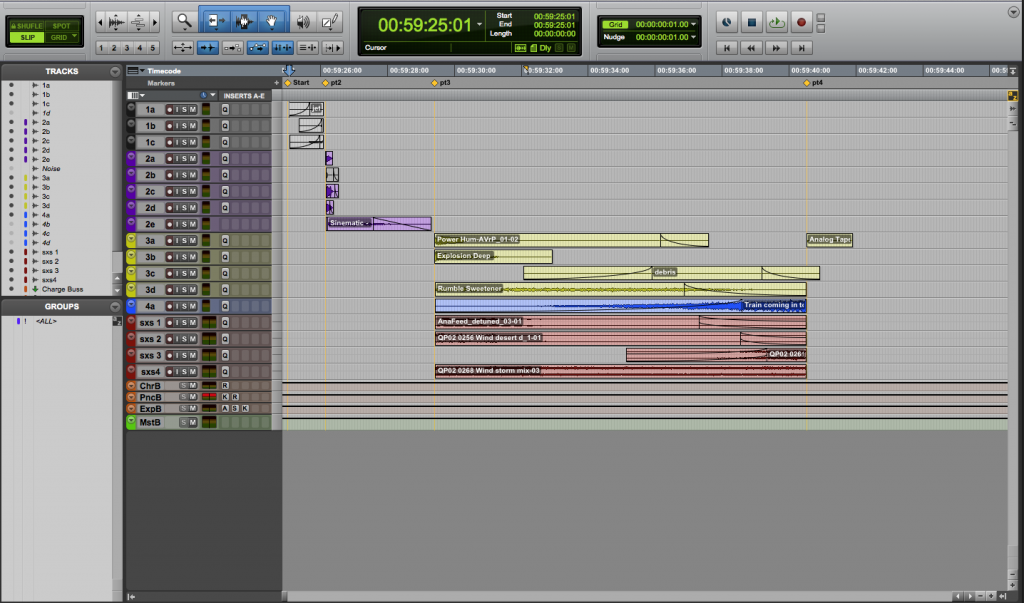
CS: I approached each sonic-part as I would normally when doing Foley – by breaking each section down into layers that I thought would help convey the appropriate energy at each given moment. One of the perks with doing sound design is I have access to many sounds in my library that wouldn’t fall under the normal category of Foley.
For example, in the first section (“build-up”) there is the sound of a jet engine servo being started. This is combined with street sweeper pass-by and a lower sub-bass to give it some weight.
The “strike/attack/impact” section includes a fairly impactful “bodyfall” element, a sine-wave kick drum to provide weight, and sub-sonic bass-drop synth to give it a sense of falling. On top of those is a layer of celery being broken – a pretty common prop used in Foley to give that bone-breaking, flesh-tearing sound. I also consciously used a bit of a trick to make the upcoming explosion really hit hard – by cutting in a bit of silence right before the first big transient.
The huge third part (which I imagined to be almost a nuclear blast) comprises of an electrical generator powering up, a deep explosion, and a rumble sweetener which, to my ears, sounds like an air-conditioning unit that has been low-pass filtered. Added to those is some falling debris and dust. For the build-up of energy (before the sound cuts out) I layered in a field recording of a train pulling into the Centraal train station in Antwerp, Belgium that I recorded back in 2015. This provided movement and a metallic screech needed to fill in the space a bit better.
Up until this point I was only using mono-sounds (sounds that are singular in their origin in relation to the stereo field). This kept the energy and details all center-aligned and allowed me to get more creative when layering stereo effects and reverbs. There is a rather large stereo synth-bass that comes in and fades out as the train rolls in, as well as several different howling wind and air-tones that add movement, chaos and some interesting detail to both the Left and Right stereo channels.
All of the sounds build up to a point where it cuts off rather abruptly at the climax. My thought was that we were viewing this image through a separate lens – perhaps even a surveillance camera. This huge surge of energy was like an atomic blast that builds in intensity the closer it gets to the viewer and once it hits, it knocks out the camera and we are left with the sound of the camera glitching out and slowly dying. This electrical sound was from an old analog tape machine.
In terms of “processing” the sound, what I did was actually quite minimal. Mostly it was just subtle EQ-ing and dynamic compression. All three “parts” were summed to their own “buss” and tweaked with reverb and compression to taste. The three busses were then routed to a Master buss for final mastering.
That’s it! That’s the extremely serious take on my favorite comic sound effect ever, but now, I have a new found respect for it and the work of sound design thanks to Szott’s excellent work here. I will never look at any of the sound effects from World War Hulk the same ever again.
Thanks to Szott for taking this project on. If you’d like to find more of him and his work, you can find him on IMDB, Twitter, Instagram and Bandcamp.
Worth noting: I have genuinely no clue if those are Vs at the end or Ws. I believe they are Vs due to the lack of the spike in the middle.↩