
There’s No Wrong Place to Start Reading Comics
On the surface, starting any comic series with its 101st issue might seem like a wild choice, especially through the prism of how we read comics today. There are any number of #1s to choose from. Why not begin with one of those?
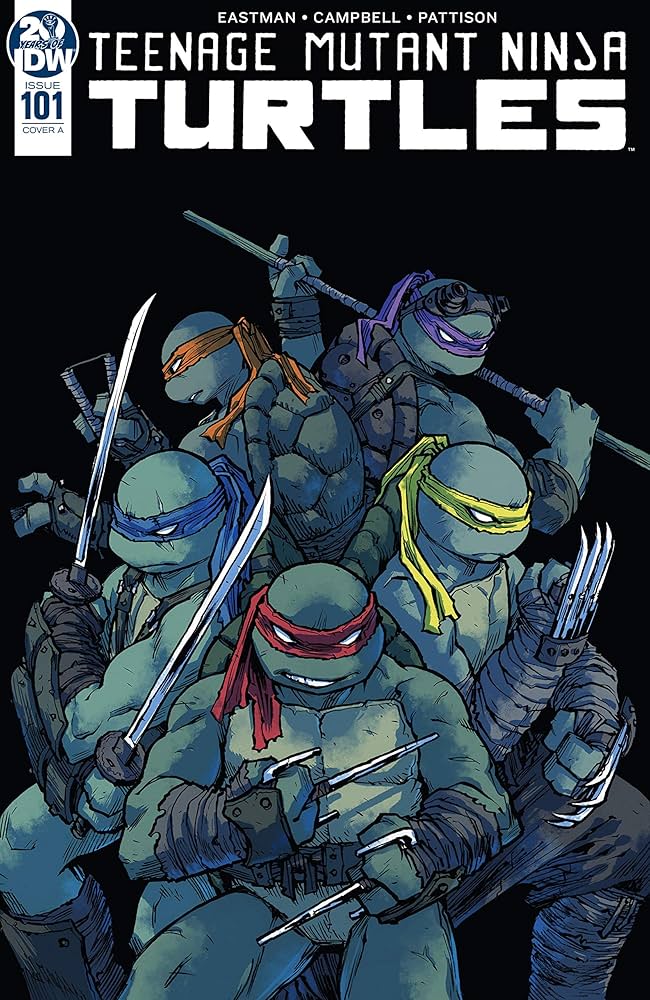
The answer to that question was pretty simple in my case. I was reading Teenage Mutant Ninja Turtles for a podcast with cartoonist Sophie Campbell, because I believe in being fully prepared for interviews. A big part of Campbell’s career has been her work with the Turtles, a franchise I had barely read since its heyday in the early 1990s. That meant I had some work to do. While Campbell had drawn the characters before, her time as a writer/artist began with that 101st issue. That felt like the right place to start, so I began there.
And hoooooo boy, was it different than anything I’d ever seen from TMNT.
I was met by Turtles that were less cowabunga and more clinically depressed, a location in New York City that now included a neighborhood called Mutant Town because many of its denizens were recently turned into anthropomorphic animals, and a situation I didn’t know anything about. It was the continuation of a larger story, one that had been building from varying threads created in recent years. Because of that, my instinct was that this would be a difficult read. Conventional wisdom suggests readers just can’t jump into a series midway through. It would be, and should be, impossible.
But it wasn’t.
Sure, I didn’t know certain characters, I wasn’t entirely sure what had happened previously, and these Turtles were going through things I’d never seen them go through before. But that wasn’t a turn off at all. Instead, it made a sign in my brain light up, one that had been left in disrepair in recent years thanks to its lack of use.
That sign said “I have to know more” in big, bold, neon letters.
So, I kept reading, both forwards and backwards, because I had to know more.
There’s a reason that sign was found covered in mothballs in a lost part of my brain. It’s incredibly rare that I start any comic with anything besides a first issue these days. It’s just not how things are done in 2025. After all, there’s no better place to start than a debut, and one is always sure to be around the corner in this era of miniseries and relaunches.
But that was not always the case.
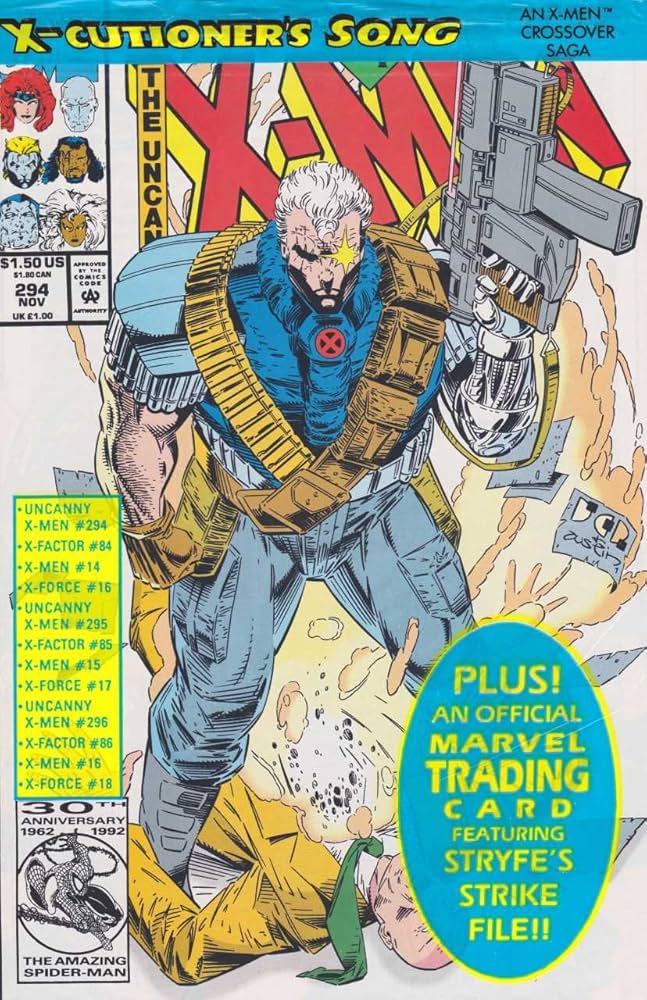
While it wasn’t the first comic I read, the first I bought for myself was Uncanny X-Men #294, the opening chapter of the X-Men crossover X-Cutioner’s Song. I was familiar with the Marvel’s Merry Mutants thanks to varying trading card sets and their arcade game, amongst other things. 11 Given that I already liked comics, 12 the idea of reading ones that starred the X-Men appealed to me.
The clincher, though, was that this comic came polybagged with a trading card in it. What the issue was about was almost immaterial to me. At that point in my life, writer Scott Lobdell and artist Brandon Peterson meant far less to me than that card. So, I used part of my allowance to buy it at the local grocery store, eagerly opened it up, marveled at the card, and then figured, “What the heck, I guess I’ll read the comic too.”
If you’ve read X-Cutioner’s Song, you know that this comic went well beyond my meager understanding of the X-Men. I recognized much of the cast, but their circumstances were different than I expected. Cable’s a bad guy, maybe? Professor X is dead, possibly? Cyclops and Jean Grey are having relationship problems, it seems? Needless to say, I had a lot of questions about what happened within its pages. But there was one thing I knew with 100% certainty after reading it.
I had to know more.
Thanks to the careful research I did by reading the backs of all my Marvel cards 13 and further issues of X-Cutioner’s Song, I started piecing things together. Just like that, my world expanded in exciting ways. I wasn’t just reading one comic so I could get a trading card; I was reading four titles in Uncanny X-Men, X-Men, X-Force, and X-Factor. X-Cutioner’s Song is an admittedly crazy crossover, but I luxuriated in its unhinged tour of the Summers family tree and the larger roster of mutant-related characters. It, in part, made me the fan I am today.
That exemplified the power of curiosity, and the power of jumping in feet first and seeing where comics takes you. This didn’t just happen to me when I was a kid, either. While it’s not as common as it once was, much of my comics journey as an adult began midway through titles and stories.
There are plenty of examples to choose from in that regard. The single issue that got me back into that format was Infinite Crisis #4. The first Mignolaverse comic I read was B.P.R.D.’s seventh arc in Garden of Souls. I’d need more hands to count the number of Image titles from 2006 to 2012 where my reads began with anything but issue #1. This was common when I was a kid, and it was common for me as an adult.
Until it wasn’t.
subscribers only.
Learn more about what you get with a subscription
This was before the animated series debuted, though.↩
Reading all the Transformers comics any single child could handle was my earliest occupation.↩
aka 1990s comic kid Wikipedia.↩
This was before the animated series debuted, though.↩
Reading all the Transformers comics any single child could handle was my earliest occupation.↩
aka 1990s comic kid Wikipedia.↩
Ranging from the 1980s to the 2010s.↩
It probably even precedes that.↩
If you have more #1s, you’ll get more opportunities at the sales bump that comes with those.↩
A fact the team actually joked about on the second #1s cover.↩
This was before the animated series debuted, though.↩
Reading all the Transformers comics any single child could handle was my earliest occupation.↩
aka 1990s comic kid Wikipedia.↩