
Chip Chat Vol. 1: The State of the Zdarsky
It's time for a new monthly interview series here on SKTCHD, this time with Chip Zdarsky.
Welcome to the first ever Chip Chat!
You might be wondering, “What’s a Chip Chat?” It’s pretty simple. Chip Chats are monthly interviews with writer, artist, and man about comics Chip Zdarsky hosted here on SKTCHD (and the SKTCHD YouTube), ones that will take place every month of this new year, 2026, with each edition diving into a different subject. If you’re a SKTCHD veteran and this sounds familiar, don’t worry: It should. I previously did a similar monthly interview series with writer James Tynion IV back in 2023. This is its sequel of a sort, but because it’s Chip, these Chip Chats are going to be much different beasts.
This first edition starts things off on a similar note as last time with a State of the Union chat, of a sort, except this one will largely zero in on where Zdarsky finds himself as he heads into a big year. The writer is crafting Marvel’s big 2026 event and a couple titles that will be hugely consequential from an architectural standpoint in Captain America and Wolverine: Weapons of Armageddon, and with those powers come different responsibilities, which we discuss here. That’s right: It’s The State of the Zdarsky, as we dig into where the industry is, how Chip fits in all of it, his new era at Marvel, where creator-owned is for him, and a whole lot more. Now, it’s worth noting we recorded this towards the beginning of January, which is why MAD About DC didn’t come up during our conversation. But we still covered a lot.
Each of these chats will publish on the SKTCHD YouTube as a video series, but only SKTCHD subscribers will get access to the transcribed version of each conversation. So, if you’re like, “ew, gross” to videos — whether they feature Chip and I or not — then I have good news for you: You can read these interviews if you subscribe to SKTCHD, and only if you do.
Except with this first one. Because it’s the beginning of an All-New, All-Different Era where Chip and I are talking every month, come hell or high water, I’m leaving this one open to non-subscribers. But this is a one time only deal! If you prefer to read this kind of thing or simply want to support the work that goes into this interview series (and everything else I do here, which is a lot!), subscribe to SKTCHD! The annual plan costs less than one comic a month, and the site is filled with tons of material about the world of comics that you just won’t find anywhere else.
But that’s enough of that. Without further ado, here’s the first Chip Chat for your viewing and/or reading pleasure. I hope you dig it.
To start, we have to check in with the most important side of Chip Zdarsky of all. Chip, how are you doing…as a person?
Chip Zdarsky: As a person, I’m okay. I made it through the holidays and we’re in year two of a house renovation. I lost my mind today. So, I just apologized to my wife for losing my mind. It wasn’t at her. I want to clarify that. I love and respect her. But I was just so mad at HVAC of all things, and I was just fuming. But yeah. I’m calming down thanks to thanks to you and your dulcet tones.
And the fact that I’m not HVAC.
Chip: And you’re not HVAC. (laughs)
You told me before we started recording that you just took a two-week break (towards the end of 2025). Is that the longest break you’ve had since you got into comics basically?
Chip: It’s the longest of my adult life.
Wow.
Chip: Probably since school, right? Summers off. I think the most I’ve ever actually taken off before that was like three days where I’ve just fully taken off. From creating, I should say. I still had to check emails because Marvel’s still sending stuff to press. People still need answers. Artists need to know if their pages are good to go for inking. Stuff like that.
You’re never fully off. I don’t know any comics person who can fully take time off. But yeah, I just I didn’t write anything. I didn’t draw anything for work. But (laughs) my downtime was I did an oil painting of Nathan Fielder for a portrait show that a friend was doing this month, and I did a giant X-Men homage drawing. Did you see it?
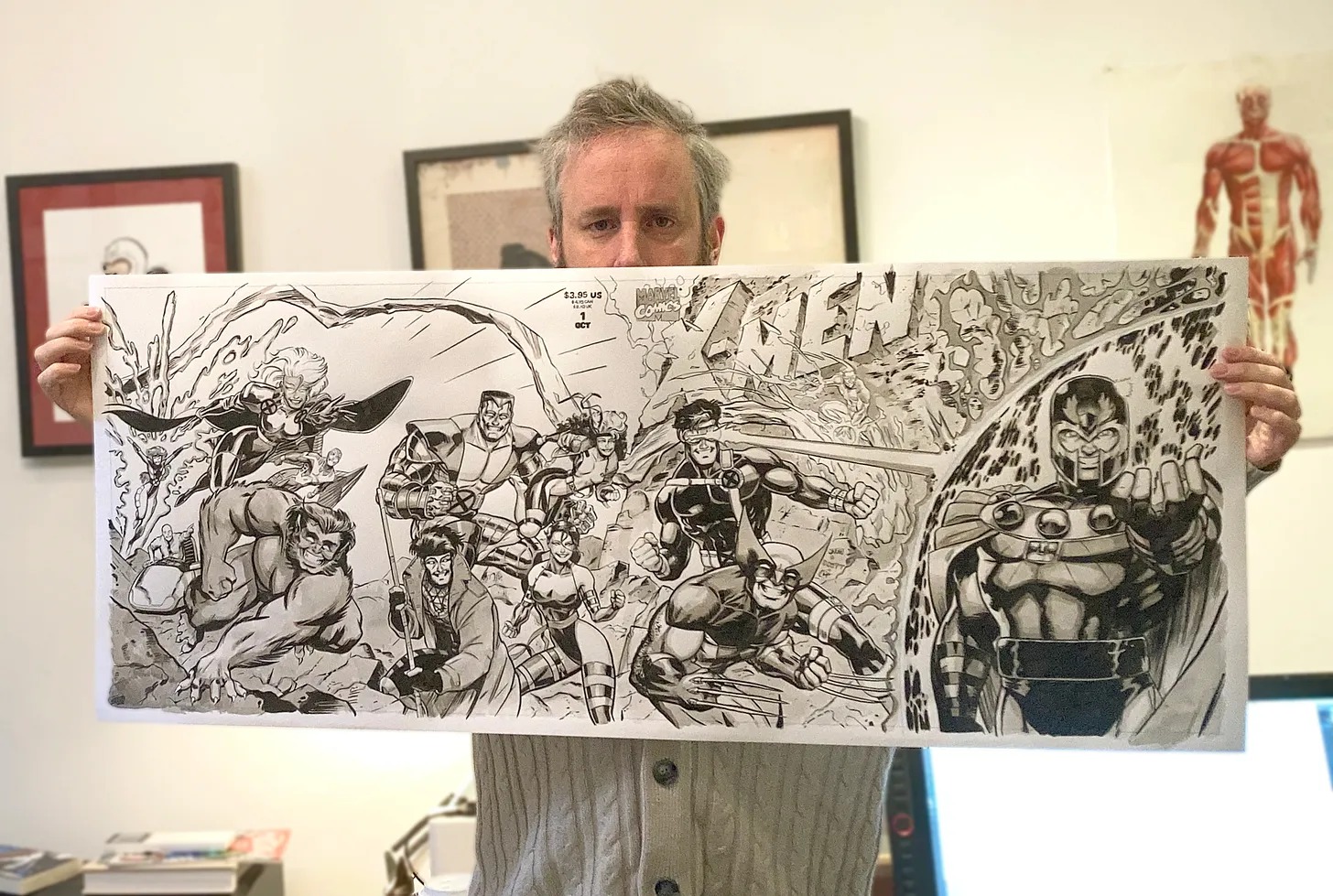
I did see it. Everyone’s smiling at the camera.
Chip: Yeah. That’s sitting on my table right now. It’s gigantic. So, I spent my time doing that, and I wrote half of a screenplay for a buddy of mine who’s a director and he’s looking for a project. I’m like, well, let me try and write something for you. That was my time off.
It’s not fully time off, but I like making things. So, I told my wife that doing this X-Men piece…for those that don’t know, I’ve been doing this homage series, which are classic comic covers, but everyone’s smiling. (shows art) (laughs)
That is massive.
Chip: It’s insane. (laughs)
Is that what took two weeks? You just did that for two weeks?
Chip: No, this was two days.
You know what would be a good X-Men cover to do that with? Days of Future Past.
Chip: It’s on my list. I’ve got the next eight planned out and that’s on there.
That took two days. It’s very rare that I spend more than a day on anything art related, so that was a long time for me. I started on Boxing Day, and my life laughed at me that this is how I relax. And I told her this is exactly what it’s like for me to do a jigsaw puzzle. That’s all I’m doing. I’m just kind of figuring it out. As I go, I’m working from a template. It’s very relaxing.
I think some people might be surprised to hear that that’s a version of somebody relaxing, You’re kind of doing your job, in a different way. But there’s a difference between doing something you have to do and doing something you want to do.
Chip: Yeah. And I after I finished it, I sent it to Jim Lee, which was a real bold move. (laughs)
What did he say?
Chip: He loved it. Thank God. And he sent me an homage cover he did. And he was just like, it’s so fun to do these because you learn so much from artists while you’re doing them. And I was like, 100%. I’ve done a couple of these now where I’m working over somebody’s work. It really makes you appreciate that artist even more and the decisions they make.
It’s a fun project. I want to do like 10, 12 of these so I can have a proper art show with them.
I’m sorry to add one more to your list. Jim Lee’s Punisher War Journal covers, the one where he steals the jet ski? Have you ever seen that one? I guess technically it states on the cover that he rented the jet ski.
Chip: Yeah, you can kiss it goodbye. (laughs)
He looks unhappy about the experience, but I feel like he could look happy.
Chip: He should be happy about it. (laughs)
It’s funny. I think Gerry Duggan said, “You have to do The Night Gwen Stacy Died.” But there’s no one on the cover where she actually dies. It’s just a bunch of random faces and some of them are already smiling. So that doesn’t do anything. And then the one after with the big reveal is like, it’s hard to show Spider-Man smiling and Green Goblin’s already smiling. So, it would just be dead Gwen Stacy smiling, which is still funny. (David laughs)
A little dark. A little too dark, maybe.
Chip: You want dark (laughs)…I’ll send you…I just did the pencils for two new ones. I’m doing a Batman: Year One cover.
The one with his parents?
Chip: No, the one of Gordon firing at Batman except Gordon’s looking at you and smiling. And I’m doing (laughs) the Green Lantern/Green Arrow one.
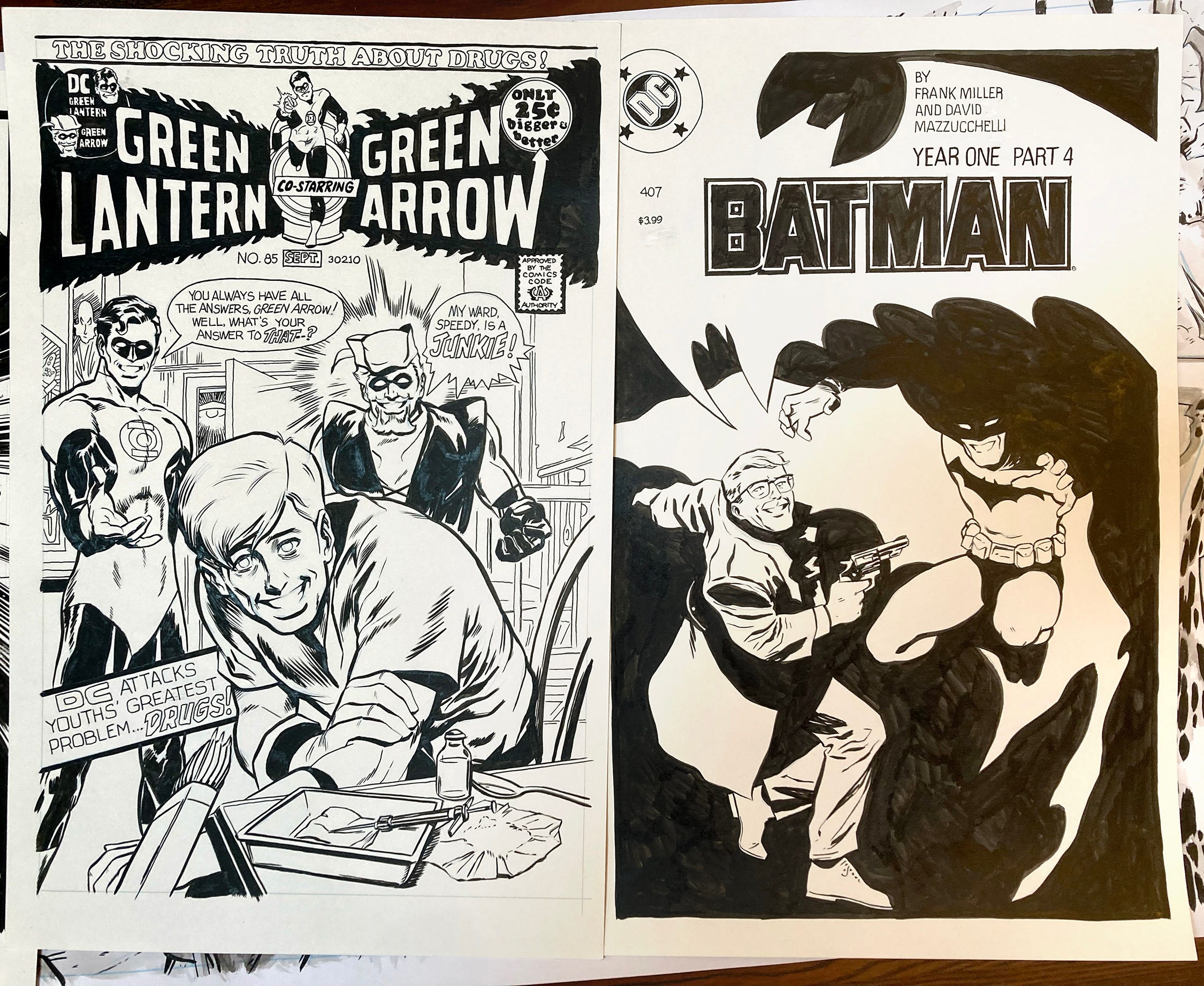
With Speedy and his drugs? (laughs)
Chip: With Speedy shooting up and looking at you and smiling (laughs), and Green Lantern and Green Arrow are smiling as they explain the situation. (laughs) It’s just good old-fashioned fun.
And there’s an artist statement behind it. People always complain, “Comics are too dark and blah blah, grim and gritty. Why can’t comics be the way they used to be?” This is just me showing that comics were always angsty and angry (laughs) and heroes fighting heroes. Like, that Cap/Wolverine cover, 1 they’ve always been like that.
Very rarely are they happy.
I strongly support this. Also, I’m glad that you’re happy. You seem like you’re really enjoying it.
I’m going to mire you in the present reality, unfortunately. It’s time to talk comics, and Chip, it’s a weird time for the world, for the comic industry, for the direct market, for recovering magazine mavens like yourself. So, let’s talk about that. How are you feeling about the health of the comic industry and, in particular, the direct market as we move into 2026?
Chip: It’s very funny that I’m kind of the follow up to you doing this with James Tynion IV, because he’s super smart and pays attention to things. I am not and I don’t pay attention to things. So, I’m going to give you such a limited worldview.
Things feel good.
Good. I’m glad.
Chip: The only thing I have to go on are just friends complaining, right? I don’t have many friends. People seem excited. All the DC stuff last year really hit. All the Absolute stuff, which is great. I think it’s well-deserved as well. It’s a great sign for everyone because they’re books that are creator first, for the most part.
And kind of the understanding within the Marvel/DC system is that it isn’t the creators that sell, it’s the characters. Maybe you can have a hot writer and a bad artist, and you’ll still sell plenty of books or vice versa. But taking risks and using artists who are just genuinely great artists who maybe you wouldn’t immediately think of for these kinds of titles…it’s huge.
I’ve heard stories in the past at both Marvel and DC about an interesting artist being brought onboard a project and higher-ups being like no, you’re going to kill this with this artist that we all agree is great but doesn’t move the needle in the comics market. There are a lot of stories like that.
Nick Dragotta, who is genuinely great. I’ve worked with him. I’ve read his stuff for years, and to see the fans and the readers just really take to his stuff is awesome. We were talking about Javier Rodriguez before this…same thing, right? Just inventive, solid layouts.
I’m bad at looking at what the market is and what the market needs, but good, strong layouts are so important, and nobody realizes it. I think a lot of people read a book and they’re like, if they go away from it, “That was okay, I didn’t really like it.” But they don’t know why they didn’t like it. I feel like nine times out of 10, it’s the storytelling. Nine times out of 10, it’s the layouts. You can look past a weird face or whatever that maybe isn’t the style you’re accustomed to, but if the impact of the layout and the storytelling hits you, then you’ve got it made.
I don’t want to disagree with you that you don’t know this as well as James or anything like that.
Chip: Definitely not as well as James. You know that. That’s a given.
But I think the foundation of why the industry did well in 2025 are the creative things you’re talking about. When you look throughout the history of comics, the high times are directly correlated to, are you taking risks in storytelling? When you take those risks, are you making them things that people respond to, things that people can understand, things like that?
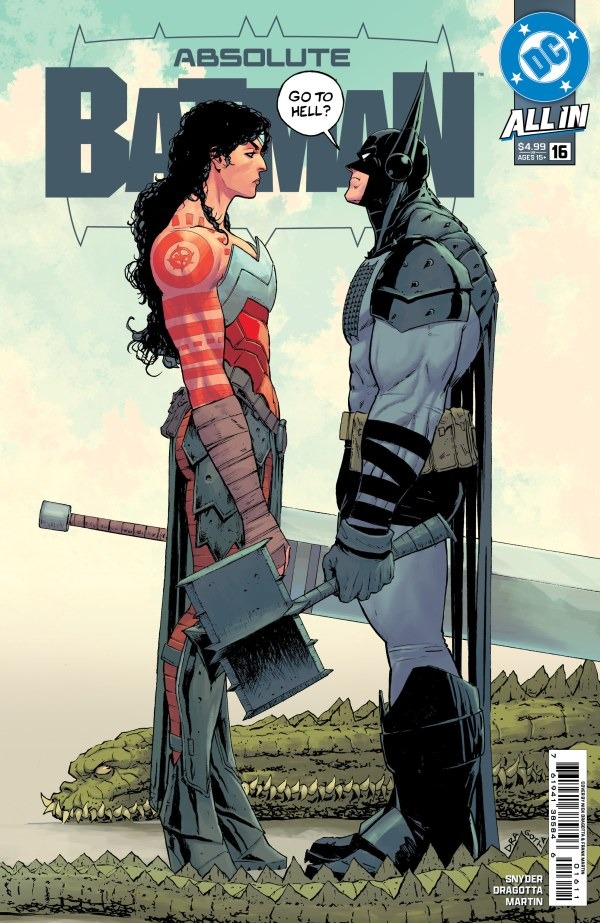
You don’t pay attention to this stuff, but 2025 brought in a lot of new readers. Every retailer I’m talking to is like, we’re seeing tons of people who are excited about Absolute coming in. I think that they’re responding to it for the same reason people responded to comics in 1986 and people responded in 2000 when Ultimate hit and yada, yada, yada.
And it’s because it’s awesome and it feels different.
Chip: Yeah. And it’s a fresh start. You can’t overlook that. DC’s always been good at that. Almost to a fault in some cases with the constant reboots. But their perennial list is deeper than Marvel’s, right? The ones you can just hand to somebody, and they get it right away. That story is its own story. And Absolute is just another example of that.
Until eventually it gets mired down in continuity, which I’m sure will happen. I’m not pretending to know what is going to happen. I don’t have that kind of insight. They’re such strong books individually, and I know that they’re, kissing here and there, with Wonder Woman showing up in Batman and Batman in Wonder Woman. Once they start doing the big crossovers, it’ll be interesting to see if they can maintain that.
Probably, because Scott’s in charge of it and Scott’s super smart. He understands how far to push that kind of thing and when to pull back. Because you want to keep the readers. You don’t want to have them be like, now I have to buy this over here to understand that. You don’t want that.
I think they know that because there’s enough history of things going off the rails as a result.
I do want to ask one question about your…I don’t know if resistance is the right word, but your lack of desire to pay super close attention to everything that’s going on in industry. Is that just because paying close attention to it doesn’t really benefit you and you just keep the blinders up so you can focus on the work itself?
Chip: Maybe a little bit. I don’t know. I’m not a sports guy, but if I was a sports guy, I wouldn’t be doing fantasy football. I’d just be watching football, right? I’d enjoy it, but I wouldn’t want to get in the weeds on who’s doing what and what coach is better. I just want to see the end result. I don’t want to know how it’s made.
Would I sell better if I did? Maybe. If I kind of understood the market better and what’s needed and what’s hitting…I don’t know if I’ve had a lot of missteps, like sometimes you’ll put a book out and it’s not the right book for that time. I’m sure I’ve done it. Others have done it. I used to pay more attention when I wasn’t a creator. I was more interested in all that stuff, and I am interested in the history of these books. I love reading interviews with creators about the history of the companies especially.
But when you’re in it, I just don’t have the time. I know there are three or four creators who…like a day doesn’t go by where they’re not on the phone with another creator gossiping or talking about the state of the market, that kind of thing. And that’s just not me. Like I’ll have maybe one proper conversation with a comic creator every month. Probably my closest friend in that regard is Gerry Duggan. And usually Gerry knows everything, so you’re kind of getting everything in the one phone call a month of what’s happening in the industry.
If I was an editor, I’d feel differently. If I was an editor, I’d follow it a lot closer.
One of the things that I’ve talked about recently is sales charts. And I’m the oddball, much to the chagrin of some of my peers in the field of comics journalism and comics podcasting. I actually don’t want sales charts back. I have complex reasons, but I don’t need to get into that here. People will tell me it would help the industry. But I’m like three of the best years in the history of the direct market were in the last five years when we didn’t have sales charts.
Chip: How would it help the industry? What’s their reasoning?
Because people would have a better idea of what’s working and what’s hotter than you might realize and it might draw more attention to titles basically. My argument is it’s a want, not a need, and that people like it. Don’t get me wrong: I like it. I am the person who plays fantasy football. I’m the person who plays fantasy baseball because fantasy football is not like intense enough for me. So, I love that stuff.
But at the same time, do I think that it’s going to materially impact Absolute Batman because people know it’s number one? Not really.
Chip: No. I don’t think readers benefit from it. Because on Monday, I’m not looking at the box office reports from Hollywood to determine what movie I should watch that week. Like, that’s just not a thing, right?
I think it used to be maybe.
Chip: But it only works with a number one. It only works with whatever is the biggest selling thing, right? Because they’ll advertise it that way. Like, number one movie in Canada, which are the commercials I get. It creates an awareness of a lot of people saw that. But finding out what’s number four doesn’t help you at all. (laughs)
“Number nine in America!”
Chip: Who is going, “It’s Uncanny X-Men at #4 this month. Maybe I should check it out!” No one’s doing that. (laughs) But if Uncanny X-Men was #1, then people are inclined to check it out. But also, they’re already checking you out. (laughs) That’s why it’s #1. And they’re probably talking about it on Twitter or Instagram or TikTok or whatever because it is #1.
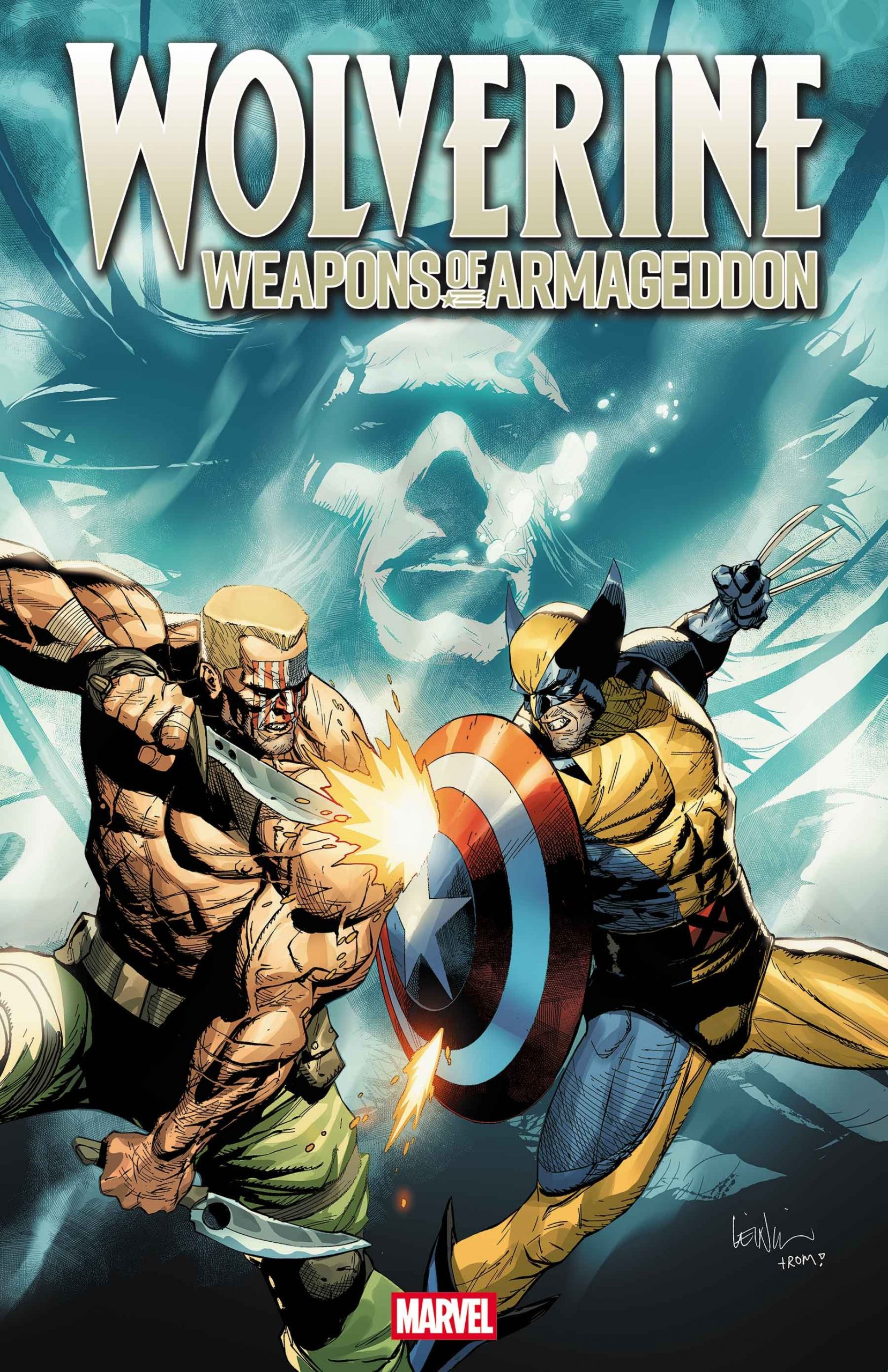
Let’s turn to the focus to you for real because you have a big year shaping up. Your Captain America run is going, and it feels like a core book for Marvel. I do want to say my friend Brandon Burpee was very excited that you’re representing gingers because he is a redhead and he supports Colton’s redheaded nature. (laughs)
Chip: Good, I’m glad. (laughs)
You have Wolverine: Weapons of Armageddon starting next month, and that’s leading into Armageddon, the big Marvel event for the year where you’re presumably destroying the Marvel Universe and that’s the end for Marvel.
Chip: Apparently.
How is 2026 looking for you right now?
Chip: It’s wild. It’s wild for a couple of reasons. One, I’m done writing them all.
Really?
Chip: Yeah. I think as of this week, I’ll have submitted my script for the final book of 2026.
Wow. This is why you can take two weeks off.
Chip: That was my wife’s reasoning. She’s like, you’re far ahead. Take some time off. But I kind of cracked the code for my schedule and my habits in 2025. I’ve just been writing a lot faster. I’m very ahead. So, that’s weird for me, because I look at 2026 and I’m already done. I still have all the art to come in, and things change. When you’re that far ahead, things can change. And you might have to rewrite a script here and there. That is the danger of being far ahead, because you don’t know what’s going to change in the world or in the publishing plans.
I haven’t signed it yet, because we negotiated before the holidays. But I’m in for another two years at Marvel. My last contract was a two-year one, and I finished it in a year. So, I’m just like…
(David makes a very surprised and confused face)
Chip: (The contract) was for two years’ worth of books. A lot of those contracts work like you have to deliver 36 issues within two years and that’s when it ends. But because there was a lot going on for this year, I just really hit the ground running and wrote a lot. So yeah, it’s weird.
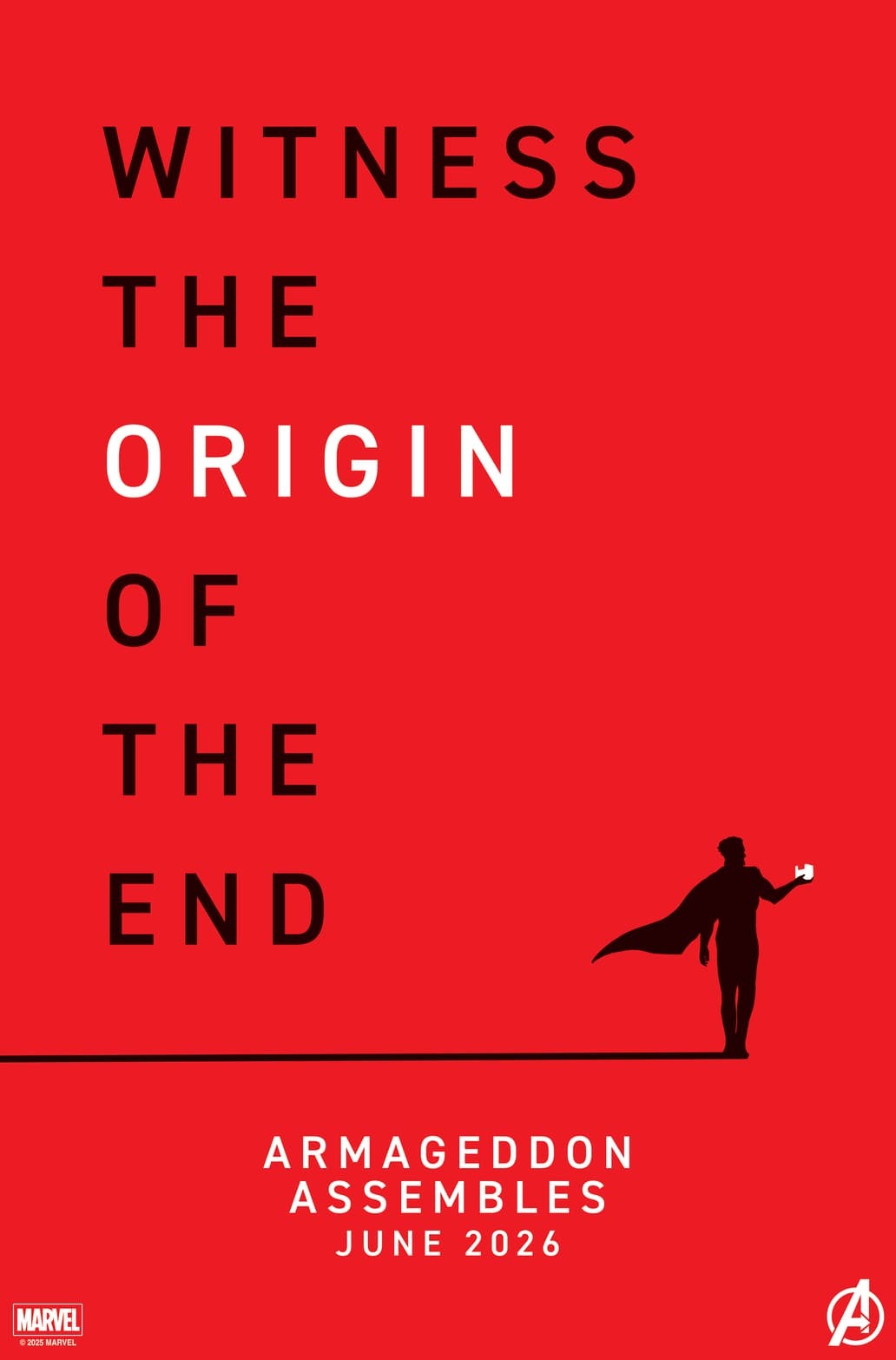
The Avengers Armageddon thing is funny because I don’t really consider it an event, but I think just because of the nature of the internet and also my striking design. (laughs)
It was very nice. It invited questions. Who is this person in the cape? What is this cube they’re holding?
Chip: That’s what you want, right? But the unfortunate side effect is it makes it seem important. And it is, but I just don’t write that way. I’m not like, alright, here’s an event. Like, I just wrote a story that I thought was like big and cool and interesting. And then Marvel’s like, “Oh wow, this is a cool event.” I’m like, I guess that’s what it’s called. And to make the event work, the Wolverine mini-series kind of cropped up in my head so we added that to it and it kind of ties into Cap, because it feels like a big thing.
God, the more I talk about it, the more I realize I’m doing an event. (laughs)
Yeah, I think you are. Also, I don’t think that readers or fans or whomever was really doing anything that Marvel themselves weren’t presenting it as. I think they even said it was their summer event, Armageddon.
Chip: Yeah, they did. I think that’s also one of the things of working so far ahead is, it means they can like start promoting it far ahead. And if they do that far ahead, that signals an event, right? Because you really have to plan those out. It’s a big story. It’s definitely the biggest thing I’ve done in terms of story and impacts on the Marvel Universe, all that stuff.
I guess the more I talk about it, I realize it’s bigger than I think it is.
I wonder if a product of you being so far out on your scripts and everything is that because you’re like, I’m just doing this because I’m telling the story, maybe Marvel could see the shape of it before you could. And now you’re realizing it. You’re like, “Wait, maybe this is an event.”
Chip: I think so. That’s probably part of it. I presented it to them on a well-designed kind of schedule too, like where things hit and how it’s going to play out and who’s on what and how many issues and so…yeah. I guess I fed the beast a little bit
That is funny too because when I said in a column that it’ll be interesting to see Chip write in an event, somebody was like, “Well, he did Devil’s Reign.” And in my head, I categorize Devil’s Reign as a Daredevil story, even though it is technically an event. But that was how you approached it. So, it’s kind of funny. You’re two for two on writing events accidentally.
Chip: Yeah…I mean, my favorite events come out of story.
I think the best events do.
Chip: Yeah. World War Hulk is one of those where it’s like Greg Pak just wrote like an amazing Hulk story and did Planet Hulk stuff and then it just felt like a natural end to that. Coming back for revenge, essentially. And that was big, and it followed on a couple years’ worth of solid stories.
Devil’s Reign felt a bit like that. I remember when I was pitching what was coming up in Daredevil, as soon as I started to talk about those events, you could just see it in the eyes of the editors that they there were like, “Okay, this could be bigger than just contained within the pages of Daredevil.” And then you rewrite based on that. Obviously, you include more characters and make the stakes a little bit bigger.
(Armageddon) is a case where it is its own thing. It wasn’t in Captain America, and I pulled it out to turn it into this. This is like writing Captain America and realizing that this could spring something out over here that’s bigger. So, we just went ahead and did that. But yeah, it’s weird and fun to come back to Marvel with Captain America, which is not normally a top selling title. And then kind of quickly present story ideas that build off it that become bigger, and then Marvel just kind of trusts me with taking that forward.
Probably my favorite stretch for Marvel, and I know a lot of people will be like, “You’re an insane person for saying this,” was the 2004 to 2010 range. And I think it was because everything felt it was organically built from story, where Brian Michael Bendis was doing Avengers Disassembled then it goes into New Avengers, and then House of M comes up, and Civil War etc. etc. It just felt like everything was built from story in a very good way.
That’s not to say it isn’t now, or it wasn’t in other times or whatever, but I like hearing how organic Armageddon is because again, I think that’s where the best stuff comes from.
Chip: I had an interesting conversation with Joshua Williamson when he was trying to figure out Iron Man. At one point he was like, “What’s the Marvel book that I should be reading that lets me know what’s happening in Marvel books?”
Fair question.
Chip: And there wasn’t one really. Everyone’s a bit siloed off. The X-Men stuff is very much X-Men, Spider-Man is Spider-Man. Jed (MacKay) is doing Avenger stuff that felt very siloed off as well. Bendis was good at that, being the guy where you read New Avengers to know what’s kind of happening at Marvel, you know.
It was the architect era.
Chip: A little bit. And Hickman as well, when he was building up his FF and Avengers stuff leading to Secret Wars. Those are the books that you read to know where the Marvel universe was heading. And it’s not to take away from any of other books. You have great stories happening elsewhere. But when you want the overview of where everything’s going, there’s usually a book to lock into and read.
I pitched it a little bit as Cap, because the second arc that’s starting up is bringing back S.H.I.E.L.D. and it’s like post One World Under Doom and thee state of the world for Marvel. And that arc leads into Armageddon and Weapons of Armageddon. And these are the titles that, if you want to know what’s happening and what we’re building towards, these are the books that you read.
You’ll see all the characters, and they’ll all come together and figure things out. And we’ve got big reveals in Armageddon, which will change the Marvel universe forever.
Finally.
Chip: There are things in Avengers Armageddon where when I pitched it, people’s eyes lit up in the room and they’re like, that’s great. And a lot of it’s just stuff that, when it happens, people are like, “of course,” right? Also, no one’s going to see it coming. It’s my favorite kind of like comic book story thing.
I was just talking to Bendis, and he was talking about his Avengers run and when he originally talked about the idea of having Wolverine and Spider-Man in the Avengers. He said he looked at Dan Buckley and saw cartoon dollar signs in his eyes. It was like, “My God, what have you done?” Excitement in the room is a big thing.
But I did want to ask, how different does your role at Marvel feel now relative to the one you had before your gap years at DC? Does it feel like it’s changed at all?
Chip: Yeah, for sure. I was lucky enough the last time I was at Marvel that some of the story things I did had legs and kept selling after I left. Like Daredevil, that omnibus sells quite well for Marvel.
Really quick aside, I saw a video quite by accident on YouTube recently where there were like 12 people discussing the 10 books or something that you should get as a first time Marvel reader. I think they agreed your Daredevil omnibus was on there. I was like…damn. Good job, Chip. So, I’m not surprised it’s selling well.
Chip: Hot damn. Yeah, I mean, it’s always your hope, and it’s nice that it sells well. I’m sure the Netflix and Disney shows help as well. So, it’s not just doing it in a void. But there’s that and then there’s Spider-Man: Life Story and Avengers Twilight. Life Story, especially when I travel, like, when I do European conventions, I’m like…this made it everywhere. This is the book I’m signing wherever I go.
I think leaving marvel and having that continue while I’m off doing Batman stuff helped Marvel’s estimation of me a little bit. They enjoy working with me. I enjoy working with them. I never left because I was like, I can’t stand whoever. That was never the case. So, coming back, it felt like…
They saw you better.
Chip: Yeah. Maybe. They were very welcoming. It was a little weird to be in the room because all of a sudden you’re like, I’m the old guy. I mean, I look in the mirror and know I’m the old guy, but it’s funny just how quickly it changes.
I’ve been doing this for 10 years and in the Marvel room for maybe seven or eight of those, but then with a two-year gap there for Batman. Now I look around the room and there’s Hickman. He’s the guy who’s still here. He’s still the smartest in the room. He’s still the best in the room. And then there’s me. And then Gerry Duggan will pop in once in a while. But a lot of the faces are kind of new. A lot of people I came in with aren’t at Marvel anymore for a variety of reasons.
That’s a weird position to be in where you’re just like, I’m the old guy. And some of the young people, they didn’t grow up reading my stuff, but they could be fans of mine. And that’s also weird because like, I didn’t have that the first go around. I was the guy who was just trying to prove myself and that I belonged in that room. So, you kind of automatically have a sense of seniority when you come back.
Which is weird. But also, you’re just more comfortable. You talked about (Marvel President) Dan Buckley and the cartoon dollar signs. I think I talked to Dan once my first go-around at Marvel. He’s the alpha in the room. He’s an intimidating figure. I didn’t have a lot to talk to him about because I was just a lowly writer, so I never went up to him on a coffee break and poked his mind about the industry.
I think this time around, I’ve probably talked to Dan more than I’ve talked to almost anyone there. We just kind of gravitate towards each other and have phone calls and talk about the industry and the future of Marvel stuff. So, that’s a different thing.
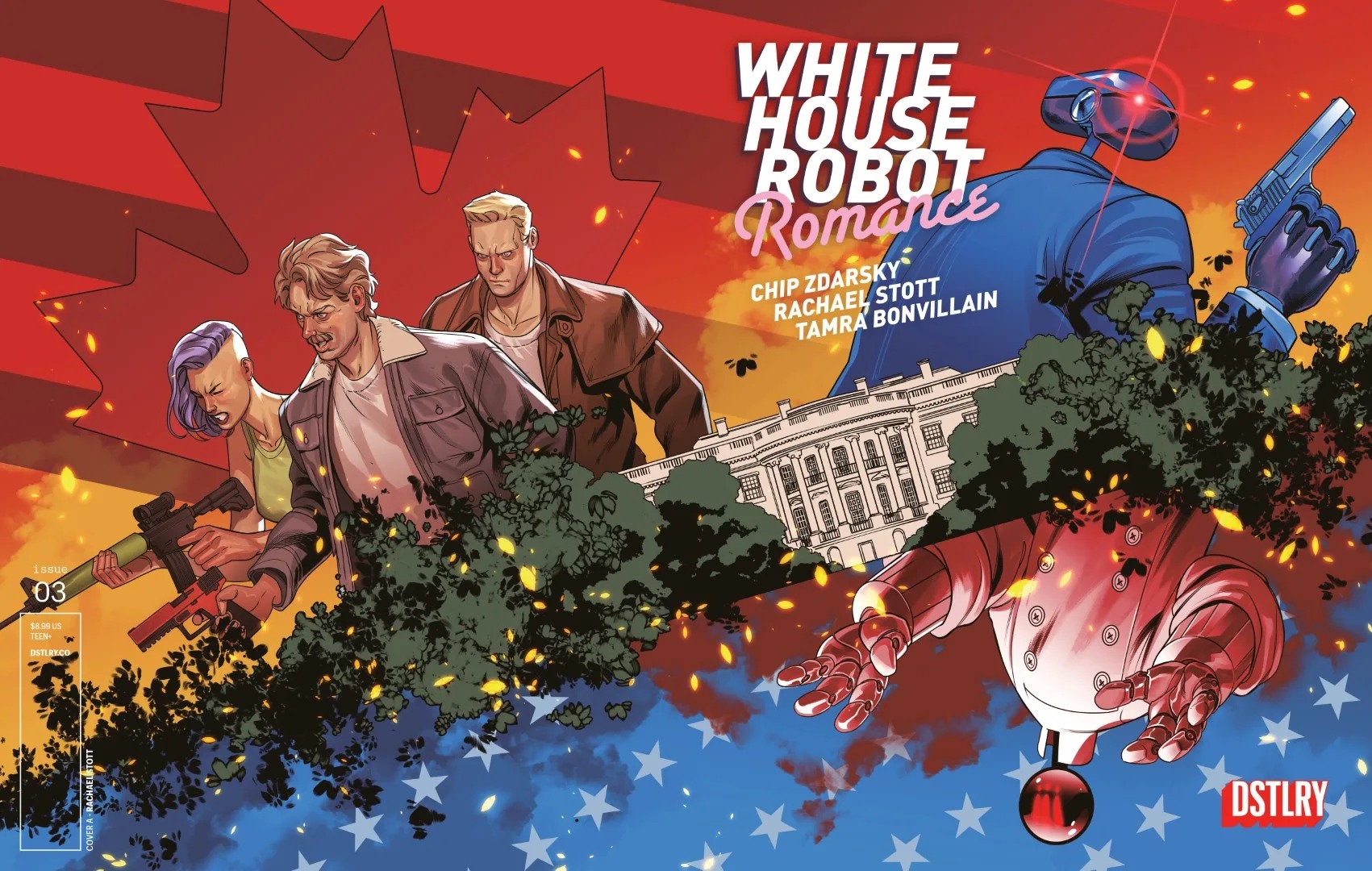
You’re done with your writing in 2026. You talked about a lot of Marvel projects. It has to be noted that White House Robot Romance is wrapping soon, which means that the only visible plans we have for you currently are at Marvel. Is that one of those situations where you have secret plans in development? Does it reflect the environment? Does it speak more to the fact that you’re busy at Marvel and there’s only so much you can do? Or is it some mix of all those things?
Chip: Maybe a mix. I have one more mini that is done that hasn’t been announced yet, so I can’t say much about it. And then Public Domain…
Woo!
Chip: Which is the thing that I’m chipping away at.
Heyo!
Chip: I know, I realized it when I said it.
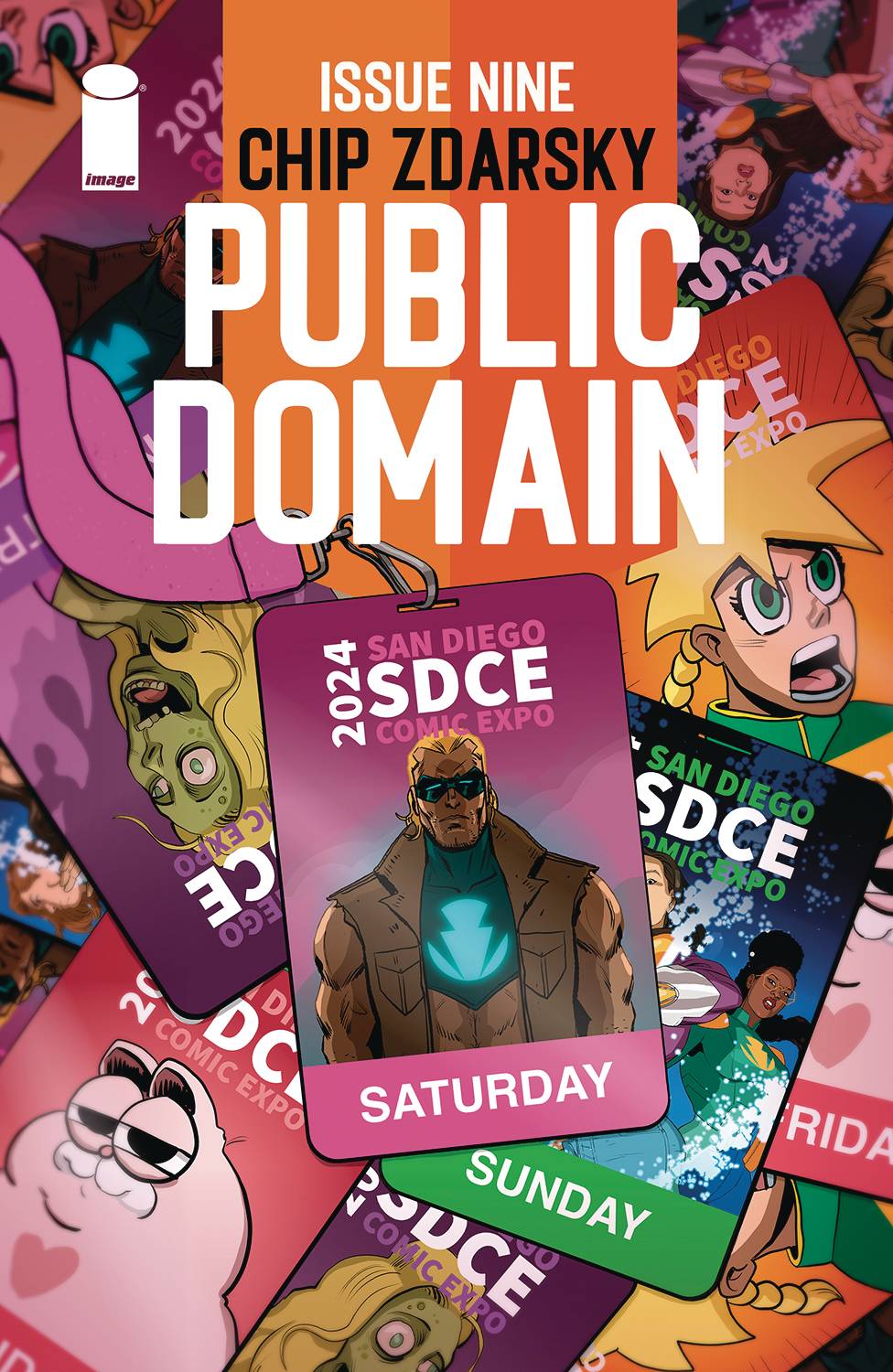
But I’m doing Public Domain in the moments when I’m not doing covers and all the scripting. So those are the priorities. I don’t want to call myself a Marvel architect, but it definitely feels like in the next year or two, I’m one of the guys that’s going to help figure out the way forward for a lot of the line. Obviously, Hickman’s kind of top dog when it comes to that kind of thing. But knowing that, I’m just like, okay, I need to focus. I need to make sure that like I’m giving this the attention it needs.
And also, creator-owned is…I love it. I’ve done very well with it. But I have to have the idea. I don’t ever want to find myself in position where I’m just like, I don’t know, maybe vampires meet aliens. I don’t want to be that guy. I don’t want to put something out just to put IP out. It has to be a thing that I really want to make with a person that I really want to make it with.
I also don’t want to ask an artist to do a thing for free. I don’t want them to devote their time to a thing that’s not going to help them feed their family. Right now, it’s a very hard place for that. So, some of the creator-owned stuff is ramping up on the Hollywood side.
Stillwater is going to be a show at Amazon. While that’s not strictly creator-owned, I’m still going to be a part of it on some level. Like the writers’ room starts end of January, I think. I’m not going to be in it. I already told them like, I don’t think it’s a good idea for me to be in it. Because I don’t want people to, I don’t want a bunch of writers in a room going through the source material and not being able to shit on it. They have to be free to do that. They have to look at it and go, yeah, this plotline sucks. We can’t do this one without them kind of looking over at me in the corner to see if I’m crying or not, which I will be.
So, I don’t want to be in the writers’ room. But I am going to visit and check in on it. If things go the way they’re supposed to go, they’ll probably start shooting before the end of the year. I want to be on set. I want to check that out. There’s another thing in the works that might get approved in the next couple of weeks. It would also necessitate a writers’ room and maybe shooting by the end of the year. So, if I have two things like that, that feels like where I want my creator-owned headspace to be. Just being able to pop in and see the fruits of my labor and consult in any way that I can on those.
I know you love doing The White Trees and The Whisper Queen with Kris Anka and Matt Wilson. But at the same time, you have to have the right idea. You also have to make sure it’s worth Kris’s time and Matt’s time and your own time. And so, it’s trying to find a balance with everything else. That’s tough.
Like, I’m sure you have to balance Public Domain with the fact that…you told me previously when you were working on Batman that you could only do Batman because it had so much responsibility for you from a universal standpoint. It’s probably the same for Marvel, so it’s all about finding a balance, right?
Chip: 100%. Public Domain is easy enough for me to, again, chip away at it off to the side because it’s just me. It’s not like there’s an artist sitting there waiting for pages and I can just be like, okay, maybe this month I’ll have a few pages done, maybe next month I’ll have 20 pages done. It doesn’t ultimately matter.
For White Trees stuff, we’ve been talking about a third part to that. Kind of the finale. I sat down and wrote 60 pages of it. I didn’t like it. So, I had to start over. That’s the other thing. There’s the space afforded because we both have jobs and so we want to make sure it’s super right before it goes out the door.
Because you’re doing it for yourself, at least in part.
Chip: 100%. We’re not making money off that thing. Technically, I’m losing money. I pay Kris, I pay Matt, I pay Hassan (Otsmane-Elhaou, its letterer). But yeah, it’s a money loser for me.
But you’re gaining joy.
Chip: But I’m gaining joy. It’s a thing I want to see in the world. The hope is, especially when it’s all finally done, we’ll put out a collection and maybe that’ll live forever. But yeah, some things you’re just doing for love of it.
Again, I’m very bad at the market.
I honestly think that people respond to those things. I don’t want to say you have to always be doing things for the right reasons. Otherwise, no slander to variant covers, but variant covers probably wouldn’t be as big of a deal as they are. But I do think that that helps. And, when you feel something that’s like that…I think that’s part of the reason why something like, Beneath the Trees Where Nobody Sees has become such a big deal. Patrick Horvath is doing that, and no one else could do that. No one else would want to do that. No one else would do it that way. It breaks so many rules of the way comics should be. And yet it is great, and it’s well done.
To close, I want to forecast out. It’s a new year. You have unlimited free time to yourself.
Chip: Exactly. (laughs)
You can just take the next year off. The world is your oyster. What has you excited about life at Zdarsco in 2026?
Chip: Honestly, the Stillwater TV show is super exciting.
There’s a great creative team behind it.
Chip: I’m so blessed to have been friends with Ramón (Pérez, its artist) for so long and to do this with him and then have this become a thing. Last year was my first time seeing a character that I created on screen with Cole North in Daredevil. That was super exciting. I became friends with the actor (Jeremy Isaiah Earl) and we’d text and call and…that’s weird. Especially when you do a Zoom call with somebody that looks like the guy that you created with your buddy Marco (Checchetto, the artist of his Daredevil run). That’s weird.
But to see a whole world based off mine and Ramon’s work, that’s going to be weird. I read the pilot. It’s great. And I’m reading it as a fan, too. I’m just like, wow, that’s cool. The changes they made were additive. Things are a bit more amped up and sped up a little bit. It’s fun to read it as a fan. If by the end of the year I’m on a set for Stillwater and I’m seeing all the characters and the town brought to life, that’s just going to be the weirdest thing that could ever happen. I’m really looking forward to that.
I know this sounds cheesy, but I’m looking forward to all the Marvel stuff. We have good, big, solid plans and I’ve got some great artists and I’m just like, let’s go. This is awesome. In February, we’re going to have our big Marvel summit. And so, I’m going to be able to talk to the room more at length about everything that’s coming up, and we could be spit balling for the next couple of years. That’s exciting. It’s exciting to be in that position and surrounded by creators that are very collaborative, and you respect.
Like again, Hickman’s the smartest guy I know, but he’s also the most helpful. In that room, he’s the guy who’s just like, “Okay, but what if he did this?” And you’re like, that’s brilliant. He’s that guy. And yeah, whenever I get to pick his brain about something, it’s awesome. So being able to figure out the next steps for the Marvel Universe with him is going to be super exciting.
If you enjoyed this first edition of Chip Chat, consider subscribing to SKTCHD for more just like it. This will be a monthly interview series, so there’s plenty more to come, and it’ll be behind the site’s paywall.
Which Chip did an homage cover to already.↩