
Revisitor: The Great Gazoo Lays the Odds on Humanity’s Survival in the Haunting and Hopeful The Flintstones #7
Revisitor is a column in which I look back on personal favorites from comic history, whether they’re a single issue, graphic novel, comic strip, webcomic or basically any form of sequential art you can think of. When I do this, my hope is to include perspective from the people who made these comics. That may not always happen, but it did this time.
It’s funny how the human brain works.
Here we are in 2026, the world and humanity itself facing immense challenges from a societal, environmental, political, cultural, and technological 13 standpoint…and all I can think about are The Flintstones.
That might sound bizarre to you. The Flintstones? The Hanna-Barbera cartoon from the 1960s that was about the modern Stone Age family from the town of Bedrock? The one that’s a page right out of history? That’s right. That one. Fred. Wilma. Pebbles. Dino. The Rubble family. The whole gang. That likely introduces a pair of important questions to your brain, both of which are completely understandable.
“Why would you be thinking about The Flintstones? And why now?”
Well, you wouldn’t be asking those questions if you read Mark Russell and Steve Pugh’s 12-issue The Flintstones series that debuted at DC on July 6th, 2016. As insane as it might sound from the outside, anyone who has read it knew immediately why it’s top of mind.
What Russell and Pugh put together across this run wasn’t a rehash of that animated series, one that played to nostalgia as it enveloped us in a cozy nest of memories. Instead, it took The Flintstones as a concept and used it to satirize and examine (then) modern society in a hilarious and brutal way. It looked at the moment we were then in and hypothesized, “What if all this nonsense started with Bedrock?” building its story out from there while using favorites like Fred, Barney, and even the animals that served their families as appliances to explore the problems we face today in ways that fit the characters.
That was all part of the plan, 14 per Russell.
“What I really wanted to do was to write the Flintstones as this manifesto about everything civilization got wrong. I wanted to take what I saw as all the foundational flaws of human civilization and blame them all on Bedrock, but in a loving sort of way, because as the world’s first civilization, it has an excuse for getting all these things wrong,” Russell said. “They didn’t know any better. This is all uncharted territory for them.”
“It’s more examining why we haven’t fixed any of this yet,” he added. “Why we’re still making the same mistakes that the world’s first civilization made in Bedrock 17,000 years ago.”
It achieved those goals and more in its Eisner Award-nominated run, 15 delivering a hysterical, pointed, absurd, thoughtful, haunting, and hopeful read across those 12 issues. Russell and his partner-in-crime in Pugh created a comic that still felt like The Flintstones, but brought a special wrinkle to it that elevated it into a level no one would have expected such a series to ever reach. It was, and is, a tremendous read for those reasons.
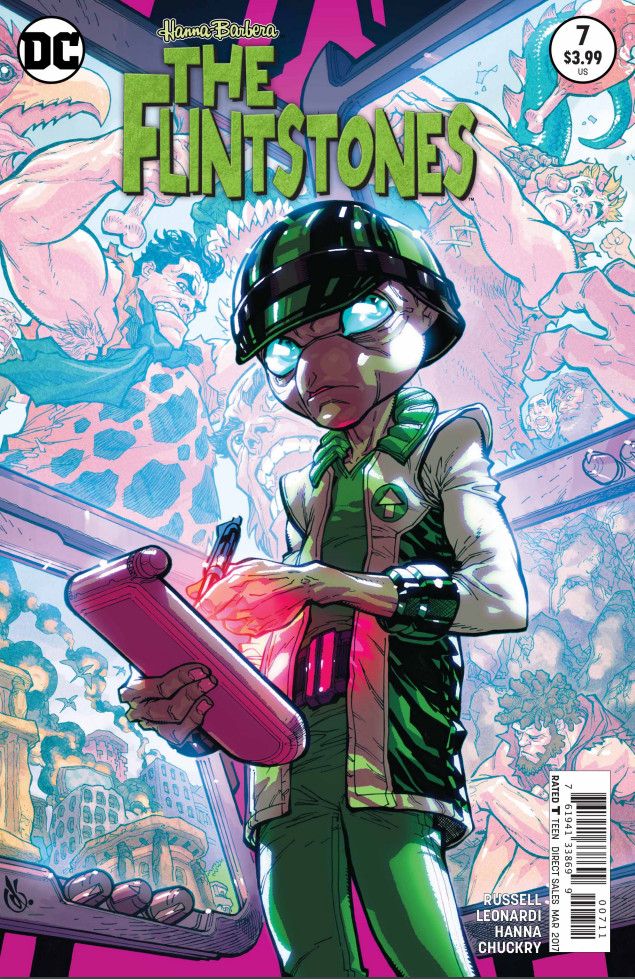
While the whole series is excellent, there’s one issue I always come back to, especially in times like these. It’s my favorite entry in this run. It’s the seventh issue, and it is, simply put, a highlight reel of humanity’s failings, one that’s expertly depicted through fill-in artist Rick Leonardi’s potent linework, and it’s a hilarious gut punch factory that still manages to hit your heart like a hammer by the end — and I mean that as a compliment.
It was also the issue that launched the second arc of the series, as Russell originally wrote The Flintstones “as two separate six issue arcs,” even if “they work together as one 12-issue story.” This issue was designed to set the stage for the rest of the series, as it reveals why The Great Gazoo was actually there after being introduced in issue #3, a crucial moment that changed the shape of this series going forward.
“The second arc was going to basically be about The Great Gazoo, who was sent to Earth to assess gambling odds on whether the human race was going to make it,” Russell said. “I wanted (issue #7) to be about him coming up with reasons to give the final odds on the planet Earth and humanity’s survival. I thought that would be the perfect way to begin that second arc, to sort of kick off the idea that this is really the contest of whether this species will make it…whether we can learn to live together in large numbers.
“And whether we’ll be able to live together in large numbers is contingent upon the idea that we will begin to be able to see people who mean nothing to us as family,” he added. “To me, that’s the great test of civilization: whether we can take care of people who mean nothing to us personally.”
Reading that, you probably understand why this issue stands out at a time like this. It’s centered on empathy, whether that’s a lack of it or having enough to care for your fellow man, with The Great Gazoo analyzing the species that reigns over the planet, human beings, throughout the issue. As the character puts it early on in the issue, that dominance “is a disaster for everyone. Even themselves.”
If that sounds like a bit of a change of pace for The Great Gazoo, a polarizing character from the animated series who mostly acted as a chaotic, Mister Mxyzptlk-like troublemaker for Fred Flinstone, Barney Rubble, their kids, and their pets, then you’re right. This isn’t your grandfather’s The Great Gazoo. Russell knows that, as he said, “of all the characters in the Flintstones, The Great Gazoo is probably the one I changed the most.”
subscribers only.
Learn more about what you get with a subscription
I’m sure that list could go on, too.↩
One Russell said “seems awfully pretentious now, because it seemed awfully pretentious then.”↩
For Best Limited Series and Best Humor Publication.↩
I’m sure that list could go on, too.↩
One Russell said “seems awfully pretentious now, because it seemed awfully pretentious then.”↩
For Best Limited Series and Best Humor Publication.↩
For the first time in his career, actually.↩
And people would happily place those bets, even if they would never be able to capitalize on those earnings.↩
As in gathered, broken stone, not Barney.↩
Mr. Slate cannot even remember his name, simply referring to him as “new guy.” Truth be told, I don’t think anyone does, as one is never given. He might not even have a name?↩
This is a reference to the most heartbreaking storyline from the series, one about the friendship between the Flintstones’ family vacuum cleaner (which is a small elephant) and Fred’s bowling ball (an armadillo). Emotionally fortify yourself before taking this comic on because it will surprise you.↩
That’s Bedrock’s version of Target in the comic.↩
I’m sure that list could go on, too.↩
One Russell said “seems awfully pretentious now, because it seemed awfully pretentious then.”↩
For Best Limited Series and Best Humor Publication.↩